ORIGINAL ARTICLE
EFFECTS OF PLASMA RADIOFREQUENCY ON PERIORBITAL REJUVENATION
EFECTOS DE LA RADIOFRECUENCIA PLASMA SOBRE EL REJUVENECIMIENTO PERIORBITAL
EFEITOS DA RADIOFREQUÊNCIA PLASMÁTICA NO REJUVENESCIMENTO PERIORBITAL
https://doi.org/10.31011/reaid-2026-v.100-n.1-art.2099
1Adamiane Moraes Schwaickardt
2Amanda dos Reis Correia
3Isabelle Araújo Oliveira
4Fernanda Melo Carneiro
5Lucas Henrique Sampaio
1Programa de Pós-Graduação em Ciências Aplicadas a Produtos para Saúde - Universidade Estadual de Goiás, Goiânia - Brazil. Orcid: https://orcid.org/0000-0003-3423-9936
2Programa de Pós-Graduação em Ciências Aplicadas a Produtos para Saúde - Universidade Estadual de Goiás. Goiânia - Brazil. Orcid: https://orcid.org/0000-0001-5378-7140
3Universidade Estadual de Goiás. Goiânia – Brazil. Orcid: https://orcid.org/0009-0006-2258-8329
4Programa de pós-Graduação em Recursos Naturais do Cerrado - Universidade Estadual de Goiás. Goiânia - Brazil. Orcid: https://orcid.org/0000-0002-2256-1883
5Programa de Pós-Graduação em Ciências Aplicadas a Produtos para Saúde Universidade Estadual de Goiás. Goiânia - Brazil. Orcid: https://orcid.org/0000-0001-6389-4564
Corresponding Author
Lucas Henrique Sampaio
Universidade Estadual de Goiás. Goiânia, Brasil. Email: lucas.sampaio@ueg.br
Submission: 27-11-2023
Approval: 26-12-2024
ABSTRACT
Objective:
To
evaluate the efficacy and safety of plasma jet radiofrequency in periorbital
rejuvenation. Methods: This experimental, longitudinal, prospective,
randomized, single-blind cohort study was conducted on 40 participants,
allocated into two groups. Volunteers underwent three bi-weekly sessions with a
Ball Tip electrode, followed by two monthly sessions with a Safe Needle
electrode. The aspects investigated were laxity, wrinkles, texture, hydration,
and dyschromia of the treated skin, as well as the occurrence of adverse
effects. The study results were evaluated through participant satisfaction
questionnaires and macroscopic analysis by researchers. Results: The
procedure with the Ball Tip was well tolerated by all participants; however,
researchers did not observe positive results in the macroscopic analysis of the
skin after three sessions. When analyzing the efficacy of radiofrequency
applied with the Saffle Needdle tip, improvement was observed in all aspects of
the skin, both based on the satisfaction survey and the macroscopic analysis of
the volunteers. Conclusion: Based on participant satisfaction surveys
and macroscopic analysis of adverse effects, the Safe Needle ablative electrode
showed better rejuvenation results in macroscopic analysis and more adverse
effects compared to the Ball Tip electrode.
Keywords: Radiofrequency Ablation; Face; Rejuvenation; Aesthetic
equipment.
RESUMEN
Objetivo: Evaluar la eficacia y seguridad de la radiofrecuencia plasmática Spectra Plasma en el rejuvenecimiento periorbitario. Metodos: Este estudio experimental, longitudinal, prospectivo, de cohorte, aleatorizado y simple ciego se llevó a cabo en 40 participantes, distribuidos en dos grupos. Los voluntarios se sometieron a tres sesiones quincenales con el electrodo Ball Tip, seguidas de dos sesiones mensuales con el electrodo Safe Needle. Los aspectos investigados fueron la flacidez, las arrugas, la textura, la hidratación y la discromía de la piel tratada, además de la aparición de efectos adversos. Los resultados del estudio fueron evaluados mediante cuestionarios de satisfacción de los participantes y análisis macroscópicos por parte de los investigadores. Resultados: El procedimiento con Ball Tip fue bien tolerado por todos los participantes, pero los investigadores no observaron resultados positivos en el análisis macroscópico de la piel después de tres sesiones. Al analizar la eficacia de la radiofrecuencia aplicada con la punta Saffle Needle, se observaron mejoras en todos los aspectos de la piel, tanto en base a la encuesta de satisfacción como al análisis macroscópico de los voluntarios. Conclusión: Según la encuesta de satisfacción de los participantes y el análisis macroscópico de los efectos adversos, el electrodo ablativo Safe Needle mostró mejores resultados de rejuvenecimiento en el análisis macroscópico y más efectos adversos en comparación con el electrodo Ball Tip
Palabras clave: Ablación por Radiofrecuencia; Rostro; Rejuvenecimiento; Equipo Estético.
RESUMO
Objetivo: Avaliar a eficácia e segurança da radiofrequência plasmática Spectra Plasma no rejuvenescimento periorbital. Métodos: Este estudo experimental, longitudinal de coorte prospectiva, randomizado e unicego foi realizado em 40 participantes, alocados em dois grupos. Os voluntários foram submetidos a três sessões quinzenais com eletrodo Ball Tip, seguidas de duas sessões mensais com eletrodo Safe Needle. Os aspectos investigados foram flacidez, rugas, textura, hidratação e discromias da pele tratada, além da ocorrência de efeitos adversos. Os resultados do estudo foram avaliados por meio de questionários de satisfação dos participantes e análise macroscópica de pesquisadores. Resultados: O procedimento com a Ball Tip foi bem tolerado por todos os participantes, porém não foram observados pelos pesquisadores resultados positivos na análise macroscópica da pele, após três sessões. Ao analisar a eficácia da radiofrequência aplicada com a ponteira Saffle Needdle, observou-se melhoria em todos os aspectos da pele, tanto com base na pesquisa de satisfação quantos na análise macroscópica dos voluntários. Conclusão: Com base na pesquisa de satisfação dos participantes e análise macroscópica dos efeitos adversos, o eletrodo ablativo Safe Needle apresentou melhores resultados no rejuvenescimento em análise macroscópica e mais efeitos adversos comparado ao eletrodo Ball Tip.
Palavras-chave: Ablação por Radiofrequência; Face; Rejuvenescimento; Equipamentos para Estética.
INTRODUCTION
According to data released by the Brazilian Institute of Geography and Statistics (IBGE), in 2024 the life expectancy of the Brazilian population reached 76.6 years, increasing by about 10 years compared to 1991(1). With the rise in life expectancy, a demographic composed of individuals who wish to age gracefully, improve their physical appearance by reducing signs of senility, and consequently enhance their self-confidence has emerged as a growing market(2).
The etiopathogenesis of the facial aging process is multifactorial, physiological, progressive, and affects all layers of the skin. This process is also associated with the senescence of the bone, muscle, and ligament structures. The periorbital region is one of the main areas to exhibit signs of aging, with concerns primarily focused on wrinkles and sagging(3,4). The periorbital area has specific characteristics of aging, including a complex array of clinical signs such as wrinkles, texture irregularities, elastosis, and dyschromias, which lead both men and women to seek aesthetic interventions(5).
The use of a non-surgical method for collagen remodeling can increase skin firmness, reduce wrinkles, diminish dermatochalasis, and substantially improve this region. Through the interaction of the device with dermal structures by heating them, the energy emitted by radiofrequency causes collagen fibrils to contract immediately, leading to an increase in blood and lymphatic circulation, which enhances the supply of nutrients and oxygen to the cells, and fibroblasts produce new collagen(6,7).
The Plasma Jet equipment device is a Brazilian technology that proposes regenerative and remodeling effects on skin tissues through superficial ablative action for the treatment of sagging and rejuvenation(8). As very few scientific studies have been conducted with plasma radiofrequency devices, and none specifically with Plasma Jet equipment, it is important to study aesthetic protocols to verify the safety and efficacy of the equipment.
OBJECTIVE
This study aimed to evaluate the safety and efficacy of the Plasma Jet equipment device in treating sagging skin and reducing cutaneous aging marks.
METHODS
The present study followed an experimental, longitudinal, prospective cohort methodology, blind and randomized. It included men and women aged between 26 and 71 years, presenting mild to severe photoaging (grade 1 or higher on the Glogau scale) with skin types II to V, who agreed to undergo plasma radiofrequency sessions for periorbital rejuvenation.
Exclusion criteria included: treatment with isotretinoin in the last six months, history of abnormal scarring (keloid or hypertrophic scar), inflammatory skin diseases, concomitant infections, cardiovascular diseases, use of immunosuppressive drugs, pregnant individuals, those who had received botulinum toxin injections or ablative procedures in the last 3 months, and individuals with implanted electronic devices (pacemakers), or copper or silver IUDs.
This experimental protocol was conducted at a public institution (State University of Goiás), following the Guidelines and Regulatory Norms for Research Involving Human Beings (Resolution 466/2012 of the National Health Council) and was duly approved by the Research Ethics Committee through the Plataforma Brasil CEP/UEG; CAAE number 21099019.9.0000.8113. All participants signed the Informed Consent Form (ICF), including permission for the use of digital photographs.
The sample consisted of 40 volunteers, aged between 26 and 71 years, divided into 2 groups: the control group (CG) and the study group (SG), each composed of 20 participants. For randomization to compose the sample, numbers were randomly selected without repetition using a free software called Random (version 2014).
An individual anamnesis script was used as a data collection instrument. For the procedure, the Plasma Jet equipment radiofrequency equipment was used with Ball Tip and Safe Needle model tips. The aspects investigated included skin laxity, wrinkles, texture, hydration, and dyschromias of the treated skin, as well as the occurrence of adverse effects.
Ball Tip Scanning Technique
In the first stage of the study, participants underwent the radiofrequency procedure using the Ball Tip. Forty participants of both sexes, with skin types II to V, were subjected to the radiofrequency procedure with the Ball Tip. In both groups (SG and CG), skin preparation was performed using 2% chlorhexidine. In the SG (N=20), three sessions of the scanning technique with the Ball Tip were conducted in the periorbital region, using 3% Raffermine dermal serum, for 10 minutes. The interval between sessions was 15 days. In the experimental group, the parameters used were a frequency of 650 kHz, a fixed amplitude of 60%, a density of 50%, and a continuous firing mode.
In the CG, the RF equipment was turned off while using the Ball Tip device, without the stimulation of the current. The CG also underwent three sessions of the scanning technique with the Ball Tip in the periorbital region, utilizing 3% Raffermine dermal serum for 10 minutes, with a 15-day interval between sessions.
Ablation Technique with Safe Needle Tip
The second stage, using the Safe Needle tip, was performed with the objective of producing concentrated and controlled focal lesions for skin tightening, according to the manufacturer's instruction manual(8). In the experimental group, to minimize risks, the parameters used were pre-defined based on skin type and conditions: density up to 20% for very thin skin, 25% for thin skin, and 35% for thick skin, with a fixed amplitude of 60% and a pulsed firing mode of T OFF’ 0.2s(9,10). Two sessions were conducted with an interval of thirty days(11,12). After the procedure, a calming moisturizer, Fisiogel, was applied. All participants were advised to avoid sun exposure without protection during the study(13). They were monitored for 6 months following the second session.
In the second stage, with the Safe Needle, the control group also underwent two sessions using the Safe Needle tip, with a thirty-day interval. The parameters used were a minimum density of 1%, a fixed amplitude of 60%, and a pulsed firing mode of T OFF’ 0.2s(8).
The reduction of wrinkles and improvement in skin texture were classified as minimal (<25%), moderate (25-50%), considerable (51-75%), or excellent (>75%). For the evaluation of results, the non-parametric Mann-Whitney test was used to compare the personal opinions of the control group with the study group regarding the improvement in skin texture and reduction in wrinkles at the end of the study. Statistically significant differences were considered for p values less than or equal to 0.05 (p<0.05).
RESULTS
The average age of the 40 participants (37 women, 3 men) was 49 ± 1.6 years. The skin of the volunteers was classified with skin types II to V. Twenty percent (20%) of the volunteers had combination skin, 25% had oily skin, and 55% had dry skin. Among the initial complaints presented by the participants, 2.5% (n=1) reported skin laxity, 5% (n=2) had facial scars due to acne or surgical procedures, 27.5% (n=11) reported deep wrinkles, 100% (n=40) had superficial wrinkles, and 12.5% (n=5) had telangiectasias.
Results with the Scanning Technique using the Ball Tip
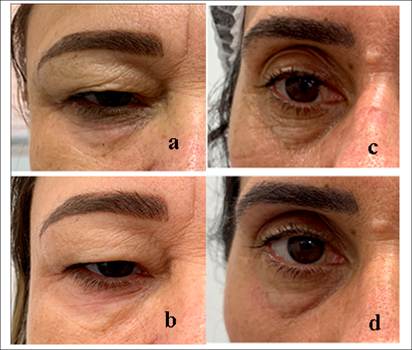
Based on the satisfaction survey, when analyzing the effectiveness of plasma radiofrequency applied with the Ball Tip electrode on the improvement of skin appearance, both the experimental group (EG) reported improvement in skin condition compared to the beginning of the treatment. However, the analysis of images did not reveal significant macroscopic improvements from the researchers' perspective after the procedures (Figure 1). The procedure with the Ball Tip was well tolerated by all participants, who reported no pain, erythema, or peeling.
 Figure
1 –
Effects of the Ball Tip Electrode
Figure
1 –
Effects of the Ball Tip Electrode
Case 1 - CG (a) Before (b) After 3 sessions. Case 2 - SG (c) Before (d) After 3 sessions.
Ablation Technique with Safe Needle Tip
Following the ablation technique with the Safe Needle tip, the variable of wrinkle/expression line reduction was classified in the Experimental Group (EG) as minimal improvement by 50% (n=10) of the participants, moderate improvement by 45% (n=9), and considerable improvement by 5% (n=1). No participant reported excellent improvement. In the Control Group (CG), 85% (n=17) experienced minimal improvement, 5% (n=1) moderate improvement, 10% (n=2) considerable improvement, and none reported excellent improvement. No individual in the control group rated their satisfaction with the treatment as excellent. Regarding the experimental group, 5% (n=1) of the individuals reported minimal improvement in skin texture, 30% (n=6) moderate improvement, 60% (n=12) considerable improvement, and 5% (n=1) excellent improvement.
When analyzing the improvement in hydration in the EG, no participant classified it as minimal, 25% (n=5) as moderate, 45% (n=9) as considerable, and 30% (n=6) as excellent. In the CG, 15% of the participants classified it as minimal, 50% (n=10) as moderate, 25% (n=5) as considerable, and 10% (n=2) as excellent. There were no reports of dyschromia. Although all participants were instructed on the importance of sunscreen use, only 27% used it. No significant difference was observed in the comparison between the EG and the CG. Table 1 provides an overview of the classification of the variables evaluated in the study and control groups.
Table 1 – Percentage of Improvement in Skin Texture, Wrinkle Reduction, and Hydration Improvement After Ablation Procedure with Safe Needle Tip.
|
|
Skin texture improvement |
Wrinkle reduction |
Hydration improvement |
|||
|
|
SG* (%) |
CG§ (%) |
SG* (%) |
CG§ (%) |
SG* (%) |
CG§ (%) |
|
Minimal |
5 |
45 |
50 |
85 |
0 |
15 |
|
Moderate |
30 |
15 |
45 |
5 |
25 |
50 |
|
Considerable |
60 |
40 |
5 |
10 |
45 |
25 |
|
Excellent |
5 |
0 |
0 |
0 |
30 |
10 |
*Study Group (SG); §Control Group (CG). Table of means generated from analyses performed in Jamovi software.
The procedure was well tolerated by all participants, who reported no pain, erythema, or peeling. Using the Safe Needle ablative electrode, 53.8% of patients reported mild pain, 46.2% moderate pain, with no reports of severe pain. The adverse effects of erythema, edema, and crusting were observed in 100% of the participants in the study group. Re-epithelialization with normalization of skin appearance occurred with an average time of 11 days. Re-epithelialization was considered to be the complete disappearance of crusts that appeared after the procedure (Figure 2b). There were no serious complications such as infections, hypertrophic scars, or eye burns. However, there was transient dyschromia (hyperpigmentation) in 30.8% of the participants in the EG (n=4), with no correlation to dosimetry. Figure 1 shows the evolution of a patient before (Figure 2a) and 6 months after the last session (Figure 2b).
A considerable aesthetic improvement was observed in the periorbital region of the study group after two treatment sessions with the Safe Needle tip. One participant 7.7% classified the wrinkle reduction as moderate, 53.8% (n=7) as considerable, and 38.5% (n=5) as excellent. Based on the satisfaction survey, when analyzing the efficacy of plasma radiofrequency applied with the Safe Needle tip in improving skin appearance, the EG showed a significantly greater improvement (p=0.04) in wrinkle reduction compared to the control group.
Figure 2– Beneficial and adverse effects after ablation with safe needle tip.
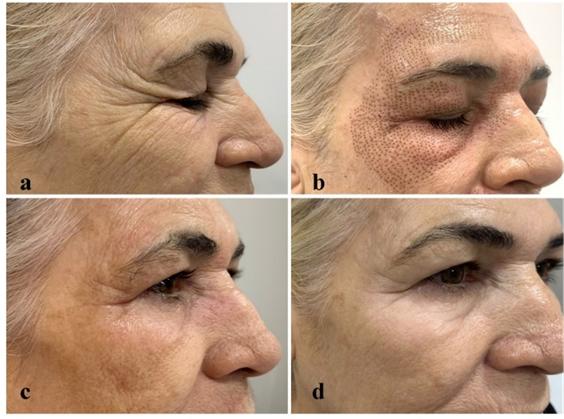
Participant SG (a) Before (b) After ablation, erythema, edema and crusts (c) transient dyschromia- hyperpigmentation 15 days after ablation (d) Improvement in skin texture, attenuated wrinkles 6 months after the second session with safe needle electrode.
DISCUSSION
The Plasma Jet equipment device utilizes energy from the ionization of atmospheric gas between the device and the skin(8). Baroni describes the mechanism of action of plasma radiofrequency, since direct contact with the skin without a spacer interrupts the emission of the electromagnetic wave(13). In this study, the Ball Tip electrode of plasma RF was used in direct contact with the skin, a sweeping technique with a cosmetic was performed, and the ablation capacity was reduced.
In both groups treated with and without electromagnetic current, no adverse effects were reported by the participants or observed by the researchers. The sweeping technique with the ball tip electrode can be considered safe, without pain, erythema, or dyschromia, if used with a topical vehicle.
We infer the observed results in improving skin texture and hydration in both groups to the active ingredient and/or the vehicle present in the Raffermine cosmetic formulation. Lage et al. (2004) describe that, to differentiate the effectiveness of the vehicle in relation to the active ingredient, a minimum period of 3 months would be necessary to discern whether the hydration, improvement in texture, and softness of the skin is provided by the vehicle or by the presence of a certain active moisturizer(14). The dry sweeping technique, without a vehicle, could generate other results and increase the ablation capacity.
Based on previous studies, the electrode mentioned for ablation points has a fine tip for energy concentration. Plasma radiofrequency ablation is performed in dosimetry and frequency chosen according to each case, each skin type, and aesthetic need. These ablations produce more concentrated thermal effects with greater depth of damage than other electrode models(15, 16).
In this study, three energy densities were selected according to skin thickness. Although 53.8% of the participants in the SG reported mild pain and 46.2% moderate pain during the procedure, there was no correlation between density and pain level.
In a comparative study between plasma radiofrequency and fractional radiofrequency by microneedling with 60 volunteers. Participants reported pain, erythema, swelling, and burning sensation after treatment with both devices. The study compared the duration interval of pain, the average duration of erythema, swelling, burning sensation, crusts, itching, and post-inflammatory hyperpigmentation. The result with the plasma RF device for treating acne scars was more effective. However, fractional RF had a shorter tissue recovery time and was more comfortable in relation to pain and fewer adverse effects(17).
In another study conducted with 35 participants using micro-plasma radiofrequency technology in the treatment of post-burn facial hyperpigmentation with the application of 10% lidocaine topical anesthetic, the only complaint of the participants was discomfort during treatments, with an average pain score of 6.7 ±0.7 on the visual analog scale from 0 to 10(7). Comparing the score of the cited study to the scale from 0 to 100 of this study (53.8% mild pain and 46.2% moderate pain, equivalent to 2.5 and 5.0, respectively, on the scale from 0 to 10), the safe needle electrode caused a lower pain score in the SG and was painless in the CG. Future clinical studies should evaluate methods to relieve pain. As a suggestion, the use of a cooler before ablation to produce cryoanalgesia, enabling a more comfortable treatment.
The pulsed firing mode T OFF’ 2s facilitated the standardization of distance between injury points to preserve surrounding tissue. Some authors consider the risk of extensive destruction to surrounding tissues significantly reduced, maintains hemostasis, and consider it possibly one of the main advantages over other technologies(18). Halachmi describes that the lesions produced in this plasma radiofrequency ablation technique can reach the superficial dermis with adequate thermal propagation for collagen stimulation(19).
In the macroscopic evaluation of the SG, 100% of the participants presented the adverse effects of cutaneous erythema and edema immediately after the sessions, followed by crusts and peeling, subsequent epidermal recovery in an average of 11 days. A pilot study used a plasma skin regeneration device in complete facial rejuvenation with reports of the same adverse effects as this study, including post-inflammatory hyperpigmentation in some patients subjected to high energy levels(20). We found no correlation of post-inflammatory hyperpigmentation dyschromia noted in 30.8% of the SG with the dosimetry used in this study.
Dyschromia with hyperpigmentation was described as the most common side effect in laser skin resurfacing, with an average incidence of 46% and an average duration of 12.7 weeks. In this context, the incidence of mild and transient post-inflammatory hyperpigmentation observed after ablation with the safe needle electrode was significantly lower than what was previously reported in laser rejuvenation studies(20).
Periorbital rejuvenation with plasma radiofrequency is a safe procedure, based on the participants' satisfaction survey, we consider it effective. The advantages of the technique used to attenuate wrinkles and skin texture involve high precision, short operation time, absence of bleeding, less damage to other tissues, rapid epidermal regeneration, no scars, and no infection.
One of the limitations found is that it is not possible to determine if there was synergy between the cosmetic and radiofrequency or if the result obtained is related only to the active or vehicle present in the cosmetic. The number of participants, another limitation, was relatively small to determine the effectiveness of plasma radiofrequency in large populations. New studies should be conducted with larger sample groups. Furthermore, it is important to conduct the same study without the use of Raffermine, to more accurately determine if the observed result in reducing sagging and expression marks is really linked to plasma radiofrequency or if part of the result is due to the use of the cosmeceutical. We also recommend that new studies be conducted, comparing different available technologies with plasma radiofrequency, to assess whether other therapies are more effective in treating and reducing wrinkles and sagging.
CONCLUSION
This study concluded that the application of radiofrequency with the Ball Tip electrode in direct contact with the skin is a safe technique, with a short operation time, without tissue injury, without dyschromia, does not cause pain or discomfort, erythema, and peeling during or after the procedure. When analyzing the efficacy of Plasma Jet equipment radiofrequency applied with the Ball Tip electrode in improving skin appearance, there was no statistically significant difference between the two groups. More clinical studies are needed to better clarify the effects of plasma radiofrequency ablation technology in a larger number of participants.
REFErences
1 Instituto Brasileiro de Geografia e Estatística. Expectativa de vida chega a 76,6 anos em 2024 [Internet]. Rio de Janeiro: IBGE Notícias; 2025 [citado 2025 Nov 28]. Disponível em: https://agenciadenoticias.ibge.gov.br/agencia-noticias/2012-agencia-de-noticias/noticias/45275-expectativa-de-vida-chega-a-76-6-anos-em-2024.
2 Russel SM, Clark JM. Periorbital rejuvenation in the clinic: A state-of-the-art review. World J Otorhinolaryngol Head Neck Surg. 2023; 9(3):242-48. DOI: 10.1002/wjo2.124.
3 Colvan L, Fleck T, Vega VL. Global periorbital skin rejuvenation by a topical eye cream containing low molecular weight heparan sulfate (LMW-HS) and a blend of naturally derived extracts. J Cosmetic Dermatol. 2019;18(2):530-38. DOI: 10.1111/jocd.12857.
4 Alexiades M. Radiofrequency Microneedling. Facial Plast Surg Clin North Am. 2023; 31(4):495-502. DOI: 10.1016/j.fsc.2023.06.010.
5 Sadick NS, Manhas-Bhutani S, Krueger N. A Novel approach to structural facial volume replacement. Aesthetic Plast Surgery. 2013;37(2):266-76. DOI: 10.1007/s00266-012-0052-6.
6 Sun Y, Luo YJ, Li Z, Yu AJ, Gong L, Li YH. Application of a new fractional radiofrequency device in the treatment of photoaging skin in chinese patients. J Cosmetic Laser Therapy. 2018;20(6):351-56. DOI: 10.1080/14764172.2018.1511908.
7 Wang LZ, Ding JP, Yang MY, Chen DW, Chen B. Treatment of facial post-burn hyperpigmentation using micro-plasma radiofrequency technology. Lasers Medical Science. 2015;30(1):241-45. DOI: 10.1007/s10103-014-1649-6.
8 Manual de uso do jato de plasma [Internet]. 2019; 5-85. Disponível em: https://manuais.smartbr.com/000000000163452/spectra-plasma-tonederm-2.pdf.
9 Sallet CG. Belíssima aos 40, 50, 60, 70. São Paulo: Conex; 2005. p. 94. Disponível em: https://books.google.com.br/books?hl=pt-BR&lr=&id=Dmuqq8e_nlUC&oi=fnd&pg=PA9&dq=raffermine&ots=QQeG93tPzh&sig=LyZ8XGyZe13CzBl-YGx6HTmjkEA#v=onepage&q=raffermine&f=false.
10 Alster T. Review of Lidocaine/Tetracaine cream as a topical anesthetic for dermatologic laser procedures. Pain and therapy. 2013;2(1):11-19. DOI: 10.1007/s40122-013-0010-2.
11 Brumana MB, Milani M, Puviani M. Efficacy of Lidocaine 7%, Tetracaine 7% self-occlusive cream in reducing MAL-cPDT-associated pain in subjects with actinic keratosis: A randomized, single-blind, vehicle-controlled trial (The “3P-Trial”). Photodiagnosis and Photodynamic Therapy. 2020; 30:101758. DOI: 10.1016/j.pdpdt.2020.101758.
12 Baroni A, Verolino P. Plasma Radiofrequency Ablation for Scar Treatment. J Clin Med. 2021; 11(1):140. DOI: 10.3390/jcm11010140.
13 Baroni A. Facial skin esthetic treatments with plasma radiofrequency ablation. J Cosmetic Dermatol. 2021;20(12):3934-39. DOI: 10.1111/jocd.14045.
14 Lage, R. et al. Cosmeceutical Ingredients: Botanical and Nonbotanical Sources. Daily Routine in Cosmetic Dermatol. 2016; 1(1): 204-19. DOI: 10.1007/978-3-319-20250-1_19-1.
15 Di Brizzi EV, Russo T, Agozzino M, Argenziano G, Giorgio CM, Calabrese G, et al. Plasma radiofrequency ablation for treatment of benign skin lesions: Clinical and reflectance confocal microscopy outcomes. Skin Res Technology. 2019;25(6):773-776. DOI: 10.1111/srt.12716.
16 Kauvar ANB, Gershonowitz A. Clinical and histologic evaluation of a fractional radiofrequency treatment of wrinkles and skin texture with novel 1-mm long ultra-thin electrode pins. Lasers Surgery Medicine. 2022;54(1):54-61. DOI: 10.1002/lsm.23452.
17 Lan T, Tang L, Xia A, Hamblin MR, Jian D, Yin R. Comparison of Fractional Micro-Plasma Radiofrequency and Fractional Microneedle Radiofrequency for the Treatment of Atrophic Acne Scars: A Pilot Randomized Split-Face Clinical Study in China. Lasers Surg Med. 2021;53(7):906-13. DOI: 10.1002/lsm.23369.
18 Carmel E, Cheng. O uso da ablação mediada por plasma (CoblationTM) em Otorrinopediatria. XI Manual de Otorrinolaringologia Pediátrica da Iapo. 2013:57-66. Disponível em: https://cdn.gn1.link/iapo/manuals/XI%20Manual%20IAPO%20GN1_v3%205.pdf
19 Halachmi S, Orenstein A, Meneghel T, Lapidoth M. A novel fractional micro-plasma radio-frequency technology for the treatment of facial scars and rhytids: a pilot study. J Cosmetic Laser Therapy. 2010;12(5):208-212. DOI: 10.3109/14764172.2010.514921.
20 Kilmer S, Semchyshyn N, Shah G, Fitzpatrick R. A pilot study on the use of a plasma skin regeneration device (Portrait PSR 3) in full facial rejuvenation procedures. Lasers Medical Science. 2007;22(2):101-109. DOI: 10.1007/s10103-006-0431-9.
Support and Acknowledgments: This study was supported by the Stricto sensu Graduate Program in Applied Sciences for Health Products at the State University of Goiás.
Conflict of interest statement:
None to declare.
Author contributions
Adamiane Moraes Schwaickardt: Conception, study design, patient recruitment, performance of radiofrequency procedures on volunteers, and writing of the text.
Amanda dos Reis Correia: Assistance in patient recruitment and final evaluation.
Isabelle Araújo Oliveira: Writing and final revision with critical participation and intellectual analysis of the manuscript.
Fernanda Melo Carneiro: Data analysis, writing, and final review with critical participation and intellectual analysis of the manuscript.
Lucas Henrique Sampaio: Supervision of the work, data analysis and interpretation, writing, and final review with critical participation and intellectual analysis of the manuscript.
Data Availability Statement
No databases were generated in this study. The information presented is described in the body of the article.
Scientific Editor: Ítalo Arão Pereira Ribeiro. Orcid: https://orcid.org/0000-0003-0778-1447
Rev Enferm Atual In Derme 2026;100(1): e026025