REFLECTION ARTICLE
ASSESSMENT OF INJURY RISK ASSOCIATED WITH SURGICAL POSITIONING IN LIGHT OF THE FUNCTIONAL CONSEQUENCES THEORY
EVALUACIÓN DEL RIESGO DE LESIONES POR POSICIONAMIENTO QUIRÚRGICO A LA LUZ DE LA TEORÍA DE LAS CONSECUENCIAS FUNCIONALES
AVALIAÇÃO DO RISCO DE LESÃO POR POSICIONAMENTO CIRÚRGICO À LUZ DA TEORIA DAS CONSEQUÊNCIAS FUNCIONAIS
https://doi.org/10.31011/reaid-2026-v.100-n.1-art.2622
Josemar Batista1
Ana Carolina Fernandes2
Anne Caroline Taborda Lopes3
Cristiane Lopes de Oliveira4
Franciele Brandt5
1 Centro Universitário UniDomBosco. Pontifícia Universidade Católica do Paraná. Curitiba, Paraná, Brazil. ORCID: https://orcid.org/0000-0001-9838-1232
2 Centro Universitário UniDomBosco. Curitiba, Paraná, Brazil. ORCID: https://orcid.org/0009-0001-2971-9831
3 Centro Universitário UniDomBosco. Curitiba, Paraná, Brazil. ORCID: https://orcid.org/0009-0009-1570-8486
4 Centro Universitário UniDomBosco. Curitiba, Paraná, Brazil. ORCID: https://orcid.org/0009-0009-1651-1597
5 Centro Universitário UniDomBosco. Curitiba, Paraná, Brazil. ORCID: https://orcid.org/0009-0004-5643-8252
Corresponding Author
Josemar Batista
Av. Presidente Wenceslau Braz, 1172 - Guaíra, Curitiba - PR, Brazil, 81010-000 - Phone: +55(41) 3213-5200- E-mail: josemar.batista@hotmail.com
Submission: 07-08-2025
Approval: 04-12-2025
ABSTRACT
Objective: to reflect on the assessment of injury risk resulting from surgical positioning, in light of the Functional Consequences Theory, as a way of maximizing the functional capacity of elderly people undergoing anesthetic-surgical procedures, promoting well-being and quality of life. Method: theoretical-reflective study on the use, by nurses, of the pressure injury risk assessment scale resulting from surgical positioning and Miller's Functional Consequences Theory to identify risk factors and implement Nursing interventions aimed at promoting the well-being of elderly patients. Results: the incorporation of internal risk factor assessment and the use of scales that predict the injury risk due to surgical positioning allow nurses to identify external factors related to the environment and procedure that impact the functionality and well-being of elderly people. This practice contributes to the planning of Nursing interventions that enhance positive functional outcomes. Final considerations: the assessment of injury risk due to surgical positioning, based on the Functional Consequences Theory, contributes to the mitigation of adverse effects in the perioperative period and guides the adoption of actions that promote the well-being and quality of life of elderly people undergoing the procedure.
Keywords: Nursing Care for Hospitalized Elderly Patients; Perioperative Nursing; Nursing Theory; Patient Safety.
RESUMEN
Objetivo: Reflexionar sobre la evaluación del riesgo de lesiones por posicionamiento quirúrgico, a la luz de la Teoría de las Consecuencias Funcionales, como una forma de maximizar la capacidad funcional de las personas mayores sometidas a procedimientos anestésicos-quirúrgicos, promoviendo el bienestar y la calidad de vida. Método: Estudio teórico-reflexivo sobre el uso, por parte de enfermeras, de la escala de evaluación del riesgo de lesiones por presión por posicionamiento quirúrgico y la Teoría de las Consecuencias Funcionales de Miller, para identificar factores de riesgo e implementar intervenciones de enfermería dirigidas a promover el bienestar de los pacientes mayores. Resultados: La incorporación de la evaluación de factores de riesgo internos y el uso de escalas predictivas para el riesgo de lesiones por posicionamiento quirúrgico permite a las enfermeras identificar factores externos relacionados con el entorno y el procedimiento que impactan la funcionalidad y el bienestar de la persona mayor. Esta práctica contribuye a la planificación de intervenciones de enfermería que mejoran los resultados funcionales positivos. Consideraciones finales: La evaluación del riesgo de lesión por posicionamiento quirúrgico, basada en la Teoría de las Consecuencias Funcionales, contribuye a mitigar los efectos adversos en el período perioperatorio y orienta la adopción de medidas que promueven el bienestar y la calidad de vida del adulto mayor sometido al procedimiento.
Palabras clave: Atención de Enfermería al adulto Mayor Hospitalizado; Enfermería Perioperatoria; Teoría de Enfermería; Seguridad del Paciente.
RESUMO
Objetivo: refletir sobre a avaliação do risco de lesão decorrente do posicionamento cirúrgico, à luz da Teoria das Consequências Funcionais, como forma de maximizar a capacidade funcional da pessoa idosa submetida a procedimentos anestésico-cirúrgicos, promovendo o bem-estar e a qualidade de vida. Método: estudo teórico-reflexivo sobre o uso, pelo enfermeiro, da escala de avaliação do risco de lesão por pressão decorrente do posicionamento cirúrgico e da Teoria das Consequências Funcionais de Miller, para identificar os fatores de risco e implementar as intervenções de Enfermagem voltadas à promoção do bem-estar de pacientes idosos. Resultados: a incorporação da avaliação dos fatores de risco internos e o uso de escalas preditoras do risco de lesão por posicionamento cirúrgico permitem ao enfermeiro identificar os fatores externos relacionados ao ambiente e ao procedimento que impactam na funcionalidade e no bem-estar da pessoa idosa. Essa prática contribui para o planejamento de intervenções de Enfermagem que potencializam consequências funcionais positivas. Considerações finais: a avaliação do risco de lesão por posicionamento cirúrgico, fundamentada na Teoria das Consequências Funcionais, contribui para a mitigação de efeitos adversos no período perioperatório e orienta a adoção de ações que promovam o bem-estar e a qualidade de vida da pessoa idosa submetida ao procedimento.
Palavras-chave: Cuidado de Enfermagem ao Idoso Hospitalizado; Enfermagem Perioperatória; Teoria de Enfermagem; Segurança do Paciente.
INTRODUCTION
The Surgical Center is a hospital unit where surgical procedures of varying complexity are performed, increasing the risk of errors. In this context, to promote safe and excellent surgical and anesthetic practices, the World Health Organization (WHO) launched, between 2007 and 2008, the Second Global Patient Safety Challenge, titled “Safe Surgery Saves Lives”(1). This protocol recommends, among other actions, the correct patient positioning on the operating table, a guideline reinforced in Brazil by the National Patient Safety Program (PNSP)(2).
Surgical positioning is recognized as an essential step in perioperative Nursing care. However, when performed improperly, it can contribute to serious and preventable incidents, such as skin and mucosal lesions(3). Despite the scarcity of multicenter studies investigating Pressure Injuries (PI) resulting from surgical positioning, local and regional studies have reported alarming rates. In Turkey, the prevalence observed was 25.7%(4), while in a Brazilian hospital it reached 37.7%(5).
Given this scenario, it is clear that the combination of factors intrinsic to the patient and elements of the operating room environment increases injury risk. Prolonged positioning during long surgeries increases bone pressure, which can cause temporary or permanent damage³. Despite technological advances, PI continues to pose a challenge to care, especially in elderly patients⁶.
Thus, the Perioperative Nursing Process (PNP) is a care method that allows nurses to use different tools to stratify risks and assess the vulnerability of elderly patients. Among these tools, the “Risk Assessment Scale for the Development of Injuries Resulting from Surgical Patient Positioning (ELPO)”(7) stands out, guiding the clinical practice of perioperative nurses. Therefore, analyzing surgical positioning in light of the Functional Consequences Theory is essential to understand that changes in the aging process interact with the position in which the patient remains on the operating table, with negative or positive functional effects, depending on Nursing care quality.
Considering that, during surgery, patients are totally dependent on the surgical, anesthesiology, and Nursing teams, especially concerning surgical positioning(3), this study aimed to reflect on the assessment of injury risk due to surgical positioning in light of the Functional Consequences Theory, as a way to maximize the functional capacity of elderly people undergoing anesthetic-surgical procedures, promoting well-being and quality of life.
METHOD
This is a theoretical-reflective study on the assessment, by nurses, of injury risk due to surgical positioning in elderly patients, through the application of the ELPO Scale, created and developed in Brazil in 2013(7), in light of Carol Miller's Functional Consequences Theory(8).
DEVELOPMENT
In the surgical field, the PNP method is based on the Nursing process, which aims to provide comprehensive, individualized, and excellent care during the three phases that make up the perioperative period. It is organized into five interrelated stages: (a) Nursing Assessment; (b) Nursing Diagnosis; (c) Nursing Planning; (d) Nursing Implementation; (e) Nursing Evaluation(9).
The Medium Range Functional Consequences Theory emphasizes that caring for elderly people involves the aging process, not limited to physiological aspects, but also to risk factors that can negatively impact them. The interaction between the changes inherent to aging and these risk factors can give rise to complex phenomena, with positive or negative functional consequences(8).
Functional consequences are understood as the observable effects of actions, risk factors, and age-related changes that influence the quality of life or performance of daily activities of elderly people. These effects encompass all levels of functioning, including body, mind, and spirit. For the author, risk factors increase the vulnerability of elderly people to negative functional consequences, understood as those that interfere with functioning and quality of life(8).
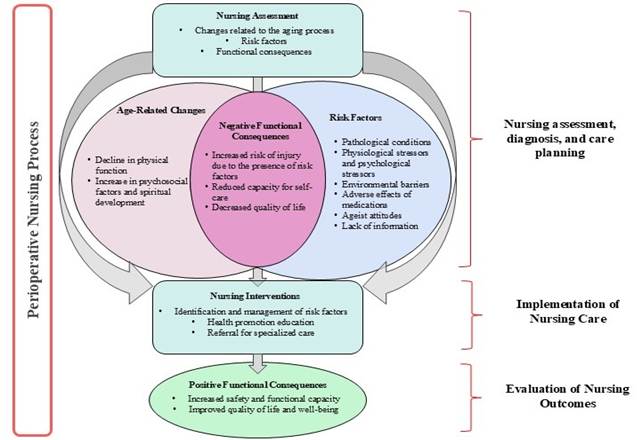
In this context, the assessment of intrinsic and extrinsic risk factors in elderly patients undergoing anesthetic-surgical procedures, especially in relation to the prevention of injuries resulting from surgical positioning, is essential to ensure patient safety, reduce negative functional consequences, and minimize dependence on nursing care, thus promoting well-being and quality of life (Figure 1).
Figure 1 - Assessment of intrinsic and extrinsic risk factors in elderly patients undergoing anesthetic-surgical procedures, according to the PNP stages, in light of the Functional Consequences Theory for the promotion of well-being
Source: Adapted from Miller(8).
Surgical units are complex environments where multidisciplinary activities, combined with the particularities of elderly patients, increase the risk of harm, such as PI, understood as negative functional consequences (observable outcomes). In this sense, by including the assessment of risk factors related to age and environment in the preoperative visit, nurses contribute to planning interventions that reduce the negative effects associated with senescence and senility. In this context, the effects of aging on the integumentary system and its impacts during the transoperative period in elderly patients are noteworthy.
It appears that the harmful effects of internal and external risk factors can arise from both the environment and physiological and psychosocial influences, directly affecting functionality and well-being. Therefore, the Functional Consequences Theory offers an approach centered on the elderly person, considering their unique characteristics in health promotion. Thus, it is assumed that the aging process brings about gradual and inevitable changes, which, when interacting with risk factors, can trigger negative functional consequences(8).
Examples include complications resulting from prolonged supine positioning of the patient, such as PI, peripheral nerve damage, and respiratory and hemodynamic changes(10). The theoretical assumptions of functional consequences allow basic Nursing actions to be planned considering prior clinical conditions, surgical time, type of anesthesia, patient vulnerabilities, and institutional surgical safety practices.
During surgery, the correct use of support and fixation equipment for surgical positioning, as well as skin protection devices in the elderly population, aims to promote positive functional outcomes, such as improved tissue perfusion, maintenance of skin integrity, comfort, and accelerated functional rehabilitation in the postoperative period.
Given this, Nursing professionals working in the operating room should investigate the elements that promote patient safety, including basic Nursing care instruments and risk stratification tools, which contribute to minimizing the negative effects of the anesthetic-surgical position. In this context, ELPO is a tool developed and validated for use in Brazil to assess risks of damage to the skin, joints, strains, nerve injuries, and pain not related to surgical incisions(7).
The scale allows for the assessment of seven items: type of surgical position, duration of surgery, type of anesthesia, support surface, limb position, comorbidities, and patient age. The score ranges from 7 to 35 points, with 19 being the cutoff score for low and high risk. The higher the score, the greater the PI risk(7). Its application contributes to maintaining positive functional outcomes, as it is a safe and effective tool for detecting potential PI risks during prolonged surgical procedures, enabling early intervention and providing support for personalized intraoperative care(3-4,7).
The implementation of evidence-based guidelines and interventions requires early and adequate assessment of the needs and risks of elderly patients undergoing surgery, ensuring safe and comfortable positioning, as well as mitigating possible negative effects(3,7). Based on risk stratification and the findings obtained by the nurse through the application of the ELPO, it is possible to manage the risks associated with the surgical position and continuously implement safe practices(3). Among these practices, the selection of support surfaces with continuous pressure redistribution, regular patient repositioning, and skin assessments stands out(4).
It should be noted that the intraoperative nurse must reduce the negative effects resulting from the surgical position, promoting the safety and functionality of the elderly patient, elements to be identified during the postoperative Nursing visit. These actions are in line with the precepts of the Association of PeriOperative Registered Nurses (AORN) in the United States, which recommends individually assessing patients to identify diagnoses and clinical problems, as well as selecting appropriate and safe nursing interventions(11). The objective is to promote well-being outcomes resulting from Nursing interventions aimed at preventing or minimizing the negative effects of perioperative care.
FINAL CONSIDERATIONS
The use of validated tools, such as ELPO, contributes to planning interventions that promote positive functional consequences and the effectiveness of perioperative Nursing care. In this context, the operationalization of the PNP model, supported by the Functional Consequences Theory, strengthens safety in perioperative care, well-being, and quality of life for elderly patients.
This research reinforces the integration between perioperative theory and practice, with an emphasis on elderly-centered care and the use of tools such as ELPO. It is hoped that this study will encourage researchers, teachers, and Nursing professionals to apply theory to care practice, promoting the translation of scientific knowledge into perioperative care and strengthening the culture of organizational safety.
REFERENCES
1. World Health Organization. Global patient safety report 2024 [Internet]. Geneva: World Health Organization; 2024 [citado 2025 Jul 14]. Disponível em: https://www.who.int/publications/i/item/9789240095458
2. Ministério da Saúde (BR). Portaria nº 529, de 1º de abril de 2013. Institui o Programa Nacional de Segurança do Paciente (PNSP) [Internet]. 2013 [citado 2025 Jul 22]. Disponível em: https://bvsms.saude.gov.br/bvs/saudelegis/gm/2013/prt0529_01_04_2013.html
3. Salvini A, Silva E, Passos C, Manuel T, Moraes C, Sousa C, et al. Validation of ELPO-PT: A Risk Assessment Scale for Surgical Positioning Injuries in the Portuguese Context. Nurs Rep. 2024 [citado 2025 Jul 8]; 14(4): 3242-63. Disponível em: https://doi.org/10.3390/nursrep14040236
4. Usul O, Dizer B. Pressure Injuries Related to the Positioning of Surgical Patients in the Operating Room and Identification of Associated Risk Factors: A Cross-Sectional Study. Int Wound J. 2025 [citado 2025 Jul 8]; 22(7):e70685. Disponível em: https://doi.org/10.1111/iwj.70685
5. Buso FDS, Ferreira MBG, Felix MMS, Galvão CM, Barichello E, Barbosa MH. Pressure injury related to surgical positioning and associated factors. Acta paul enferm. 2021 [citado 2025 Jul 8];34:eAPE00642. Disponível em: https://doi.org/10.37689/acta-ape/2021AO00642
6. Donofre LM, Oliveira RTS, Oliveira KRE, Ramos SHS, Ferreira CS, Ávila MAG. Pressure ulcer risk due to surgical positioning in adults and older adults. Revista SOBECC. 2025; 30: e1032. Disponível em: https://doi.org/10.5327/Z1414-44251032
7. Lopes CM, Haas VJ, Dantas RA, Oliveira CG, Galvão CM. Assessment scale of risk for surgical positioning injuries. Rev Lat Am Enfermagem. 2016;24:e2704. Disponível em: https://doi.org/10.1590/1518-8345.0644.2704
8. Miller CA. Nursing for wellness in older adults. 6. ed. Wolters Kluwer Health: Lippincott Williams & Wilkins, 2012.
9. Gnatta JR, Poveda VB, Ribeiro E, Duran ECM, Lopes CT, Lemos CS, et al. Perioperative Nursing Process: reflection on updating the SAEP nomenclature. Rev Esc Enferm USP. 2025;59:e20250165. Disponível em: https://doi.org/10.1590/1980-220X-REEUSP-2025-0165en
10. Maya AMS, Galeano SPO. Nursing Care Related with Surgical Position. Invest Educ Enferm. 2023;41(1):03. Disponível em: https://doi.org/10.17533/udea.iee.v41n1e03
11. Benze C, Spruce L, Groah L. Perioperative nursing: Scope and standards of practice [Internet]. Denver, CO: AORN, 2021 [citado 2025 Jul 30]. Disponível em: https://www.aorn.org/docs/default-source/guidelines-resources/periop-nursing-scope-standards-of-practice.pdf?sfvrsn=c532cdee_1
Funding and Acknowledgments:
Not applicable.
Authorship Criteria (Authors' Contributions)
1. Conception and/or planning of the study: Josemar Batista, Ana Carolina Fernandes, Anne Caroline Taborda Lopes, Cristiane Lopes de Oliveira, and Franciele Brandt. 2. Data acquisition, analysis, and/or interpretation: Josemar Batista, Ana Carolina Fernandes, Anne Caroline Taborda Lopes, Cristiane Lopes de Oliveira, and Franciele Brandt. 3. Writing and/or critical review and final approval of the published version: Josemar Batista, Ana Carolina Fernandes, Anne Caroline Taborda Lopes, Cristiane Lopes de Oliveira, and Franciele Brandt.
Conflict of Interest Statement
Nothing to declare.
Scientific Editor: Ítalo Arão Pereira Ribeiro. Orcid: https://orcid.org/0000-0003-0778-1447
Rev Enferm Atual In Derme 2026;100(1): e026007
 Atribuição
CCBY
Atribuição
CCBY