INTEGRATIVE REVIEW
NEGATIVE PRESSURE WOUND THERAPY IN THE MANAGEMENT OF CHRONIC WOUNDS: AN INTEGRATIVE REVIEW
TERAPIA POR PRESSÃO NEGATIVA NO TRATAMENTO DE FERIDAS CRÔNICAS: UMA REVISÃO INTEGRATIVA
TERAPIA DE PRESIÓN NEGATIVA PARA EL MANEJO DE HERIDAS CRÓNICAS: UNA REVISIÓN INTEGRAL
https://doi.org/10.31011/reaid-2026-v.100-n.3-art.2689
1Tamara Carla Assunção Vieira
2Luciana Ramalho de Oliveira Barbosa
3Suzani Pereira da Silva
4Monica Mattozinho de Souza
5Helena D’Anunciação de Oliveira
6Patrícia Britto Ribeiro de Jesus
1Faculdade de Ciências da Saúde Archimedes Theodoro, Além Paraíba, Brasil. ORCID: 0009-0005-7272-8249;
2Universidade do Estado do Rio de Janeiro - UERJ, Rio de Janeiro, Brasil. ORCID: 0009-0003-6093-2088;
3Centro Universitário Augusto Motta, Rio de Janeiro, Brasil. ORCID: 0009-0002-4100-8634;
4Universidade Federal Fluminense - UFF, Rio de Janeiro, Brasil. ORCID: 0009-0000-6988-9766;
5Universidade do Estado do Rio de Janeiro - UERJ, Rio de Janeiro, Brasil. ORCID: 0000-0003-2744-3496;
6Universidade do Estado do Rio de Janeiro - UERJ, Rio de Janeiro, Brasil. ORCID: 0000-0003-4523-3740
Corresponding Author
Helena D’Anunciação de Oliveira
Universidade do Estado do Rio de Janeiro – UERJ. Boulevard. 28 de Setembro, 157 - Vila Isabel, Rio de Janeiro - RJ, Brazil. CEP: 20551-030. phone: +55 (21) 2587-6335. E-mail: hdanunciacao@gmail.com
Submission: 18-11-2025
Approval: 29-07-2026
ABSTRACT
Introduction: The development of skin lesions is a common pathophysiological condition in bedridden elderly individuals. Therefore, maintaining skin integrity in these patients requires knowledge and the application of appropriate and effective care. In 1997, during the American Wound Care Congress, a new concept in wound treatment was introduced: vacuum-assisted closure. Objective: To identify the use of negative pressure wound therapy in patients with chronic wounds and to describe its characteristics and clinical applications. Method: An integrative literature review was conducted. A search was undertaken in the LILACS, BVS, Scielo, and Google Scholar databases using the terms "negative pressure therapy" and "patients with chronic lesions", between June and July 2025. After applying inclusion and exclusion criteria, 10 articles were selected and analyzed. Results: The main risk factors for lesions were identified as the elderly population and people with comorbidities, especially diabetes. Negative pressure therapy demonstrated the ability to reduce tissue edema and exudate, as well as promote the preparation of the wound for procedures such as grafting. Conclusion: Negative pressure therapy offers several benefits in the treatment of chronic wounds, including reducing wound size, decreasing bacterial load, and attenuating the local inflammatory response.
Keywords: Aging, Wounds, Negative Pressure Therapy.
RESUMO
Introdução: O desenvolvimento de lesões cutâneas é uma condição fisiopatológica frequente em pessoas idosas acamadas. Dessa forma, a manutenção da integridade da pele nesses pacientes depende do conhecimento e da aplicação de cuidados adequados e eficazes. Em 1997, durante o American Wound Care Congress foi introduzido um novo conceito para o tratamento de lesões: a terapia por pressão negativa. Objetivo: identificar o uso da terapia por pressão negativa em pacientes crônicos que apresentam lesões, bem como demonstrar suas características e funcionalidades. Método: Revisão integrativa da literatura. A busca ocorreu nas bases LILACS, BVS, SciELO e Google Acadêmico, utilizando os descritores “terapia por pressão negativa” e “pacientes com lesões crônicas”, entre junho e julho de 2025. Após aplicação dos critérios de inclusão e exclusão, 10 artigos foram selecionados e analisados.Resultados: Identificaram-se como principais fatores de risco para o desenvolvimento de lesões a idade avançada e a presença de comorbidades, especialmente o diabetes. A terapia por pressão negativa demonstrou capacidade de reduzir edema tecidual e exsudato, além de favorecer o preparo do leito da lesão para procedimentos como enxertia. Conclusão: A terapia por pressão negativa apresenta diversos benefícios no tratamento de lesões crônicas, incluindo redução das dimensões da lesão, diminuição da carga bacteriana e atenuação da resposta inflamatória local.
Palavras-chave: Envelhecimento, Lesões e Terapia por pressão negativa.
RESUMEN
Introducción: El desarrollo de lesiones cutáneas es una condición fisiopatológica común en ancianos encamados. Por lo tanto, mantener la integridad de la piel en estos pacientes es crucial para comprender e implementar una atención adecuada y efectiva. En 1997, durante el Congreso Americano de Cuidado de Heridas, se introdujo un nuevo concepto en el tratamiento de heridas: el cierre asistido por vacío. Objetivo: Identificar el uso de la terapia de presión negativa en pacientes con heridas crónicas, así como describir sus características y aplicaciones clínicas. Método: Se realizó una revisión bibliográfica integrativa. La búsqueda se llevó a cabo en las bases de datos LILACS, BVS, SciELO y Google Scholar, utilizando los descriptores “terapia de presión negativa” y “pacientes con lesiones crónicas”, entre junio y julio de 2025. Tras la aplicación de los criterios de inclusión y exclusión, se seleccionaron y analizaron 10 artículos. Resultados: Se identificaron como los principales factores de riesgo para las lesiones la edad avanzada y la presencia de comorbilidades, especialmente la diabetes. La terapia de presión negativa ha demostrado su capacidad para reducir el edema y el exudado tisular, así como para favorecer la preparación del lecho de la herida para procedimientos como el injerto. Conclusión: La terapia de presión negativa ofrece múltiples beneficios para el tratamiento de lesiones crónicas, incluyendo la reducción del tamaño de la lesión, la disminución de la carga bacteriana y la atenuación de la respuesta inflamatoria local.
Palabras clave: Envejecimiento, Lesiones y Terapia de Presión Negativa.
INTRODUCTION
Aging encompasses changes across all body systems; senescence is considered a biological process, with each individual aging in a unique way(1).
The Brazilian age pyramid has shifted in recent years, showing a significant increase in the elderly population, which currently represents one of the country's largest demographic segments. This scenario demands greater attention to the health of this population, particularly in long-term care institutions, where patients with complex conditions require specialized care(2).
Progressive population aging presents a major public health challenge, especially in developing countries where social inequality exists and longevity does not always go hand in hand with improved quality of life(2). The development of skin lesions is a common pathophysiological condition among bedridden elderly individuals; therefore, maintaining skin integrity in these patients relies on the knowledge and application of appropriate, effective care.
The skin, the human body's largest organ, plays an essential role as a protective barrier against the external environment(3). Any breach in its integrity is considered a lesion. The healing process that begins after such a breach involves a series of coordinated, interdependent events distributed across four main phases: hemostasis, inflammation, proliferation, and, finally, maturation and remodeling.
Lesions can be classified as acute or chronic. Acute lesions exhibit a controlled inflammatory response and follow a predictable healing pattern, typically closing without complications within three weeks of onset. Chronic lesions, conversely, fail to progress adequately through the ordered stages of healing, remaining stalled in the inflammatory phase despite appropriate management. They may persist for anywhere from four weeks to more than three months(4). Some wounds are considered complex due to healing difficulties, which increases overall treatment costs, including supplies and human resources. With the significant rise in cases of complex wounds, healthcare professionals working directly in this field are paying closer attention to wound care, given that depending on the complexity such wounds can lead to death(5).
Patients with chronic conditions, particularly those who are bedridden for extended periods, are prone to developing pressure injuries, among other chronic wounds. The etiology of pressure ulcers is not yet fully understood; however, it is known that continuous pressure on the skin leads to ischemic phenomena associated with nutrient deficiency and, consequently, tissue necrosis. These ulcers can develop in areas where pressure is exerted over bony prominences, such as the sacrum, ischium, and trochanter, or less frequently the calcaneus, occipital region, dorsum of the foot, malleolus, and patella(6).
METHODS
This is an integrative literature review aimed at synthesizing published knowledge regarding the elderly and the main changes in their skin, from the perspective of nursing professionals specializing in dermatology. Thus, the study seeks to understand the subject through the lens of the authors reviewed and to highlight gaps that should be addressed by future studies complementing this review.
Conducting an integrative review requires following six distinct steps, similar to the stages of conventional research development. These steps include: identifying the topic and selecting the hypothesis or research question; establishing inclusion and exclusion criteria for studies (sampling or literature search); categorizing the studies; evaluating the studies included in the review; interpreting the results; and, finally, presenting the review or knowledge synthesis(9).
The study will follow these steps: formulating the research question, searching databases, selecting and categorizing studies, evaluating the selected studies, and discussing and interpreting the results.
To conduct this integrative review, the following question was used: What are the characteristics and functionalities of negative pressure therapy in chronic patients with wounds?
Searches were conducted in the following databases: the Virtual Health Library (VHL), using the LILACS (Latin American and Caribbean Health Sciences Literature) database SciELO, and Google Scholar. Two authors performed the searches during the same period in which the reading, inclusion, and exclusion of studies took place. Inclusion criteria were: studies indexed in the databases and published in Portuguese; no time-frame restriction; published by nurses and/or health professionals; in article format; and available online as full-text documents. Exclusion criteria included: research not indexed in the specified databases, theses, dissertations, review studies, and duplicate publications found across different databases. To gather information, controlled descriptors were defined based on the Health Sciences Descriptors (DeCS) terminology; the descriptors were then combined using the Boolean operators "AND" and "OR" to ensure a broad search on the topic. Based on these descriptors, a search for articles was conducted between June 15 and July 30, 2025. The chart below shows the descriptor combinations and the number of results found in each database:
Chart 1 - Articles selected based on databases and descriptors
|
Database |
Keyword or descriptors and the Boolean operator "AND" |
Articles Found |
Selected Articles |
|
SCIELO |
(“Terapia por pressão negativa”) OR (“Terapia” OR “Cuidados de Enfermagem” OR “Tratamento por pressão negativa”) AND (“Pacientes com lesões crônicas”) |
15 |
04 |
|
BVS |
(“Terapia por pressão negativa”) OR (“Terapia” OR “Cuidados de Enfermagem” OR “Tratamento por pressão negativa”) AND (“Pacientes com lesões crônicas”) |
3 |
02 |
|
LILACS |
(“Terapia por pressão negativa”) OR (“Terapia” OR “Cuidados de Enfermagem” OR “Tratamento por pressão negativa”) AND (“Pacientes com lesões crônicas”) |
8 |
0 |
|
GOOGLE ACADÊMICO |
(“Terapia por pressão negativa”) OR (“Terapia” OR “Cuidados de Enfermagem” OR “Tratamento por pressão negativa”) AND (“Pacientes com lesões crônicas”) |
6 |
04 |
|
Total |
|
32 |
10 |
Source: Survey data, 2025.
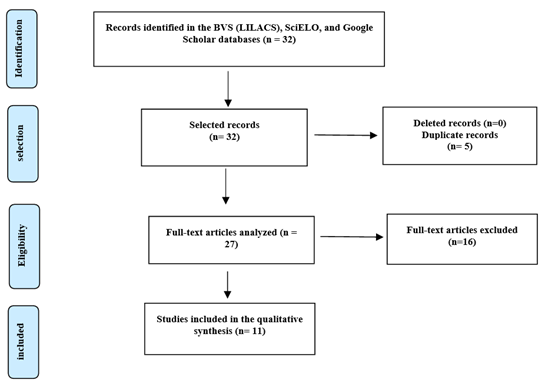
Thus, 32 scientific publications were identified; after applying the inclusion and exclusion criteria, the final sample consisted of 10 studies, as shown in Figure 1.
Figure 1 - Flowchart of the article search and selection process. Rio de Janeiro, RJ, Brazil, 2025.
Source: Research data (2025).
RESULTS
During the critical analysis phase of the data informed by the researchers' prior knowledge and the literature search an in-depth reading and analysis of the identified articles were conducted, grouping them by thematic similarity in their approaches.
Thus, Chart 2 presents the scientific output, detailing the author, year of publication, database/material type/location, and article title.
Chart 2 - Presentation of the synthesis of articles included in the integrative review. Rio de Janeiro, RJ, Brazil, 2025.
|
Author (s) |
Year |
Database / material type / locationi |
Títle |
|
Freire et al. (10) |
2020 |
Google Acadêmico |
Nursing Care for a Patient with Surgical Wound Dehiscence: An Experience Report |
|
Ferreira, Paggiaro (11) |
2010 |
BVS |
Negative-pressure wound therapy (vacuum-assisted closure). |
|
Araújo et al. (12)
|
2021 |
Scielo |
Virtual reality for pain relief during chronic wound dressing changes |
|
Santos TL et al. (13) |
2019 |
Google Acadêmico |
Negative pressure wound therapy |
|
Muniz et al. (14) |
2023 |
Google Acadêmico |
Low-cost negative pressure therapy equipment: an experience report |
|
Silva et al. (15) |
2020 |
Google Acadêmico |
Management of negative pressure wound therapy (NPWT) for complex wounds |
|
Pedrosa et al. (16) |
2024 |
Scielo |
Efficacy of negative pressure therapy in the treatment of complex wounds: an integrative literature review |
|
Postanovski et al. (17) |
2024 |
BVS |
Prevention and Treatment of Pressure Injuries in Older Adults: An Integrative Review |
|
Batra RK, Aseeja V (18) |
2014 |
Scielo |
Can VAC therapy in large (grade IV) infected sacral pressure ulcers be an alternative to flap reconstruction? |
|
Junkes Hoepers et al. (19)
|
2022 |
Scielo |
Cost of vacuum-assisted wound closure in a hospital in southern Santa Catarina. Journal of Science & Humanization of the Hospital de Clínicas de Passo Fundo. |
Ten scientific articles regarding the treatment of wounds in chronic patients and negative pressure wound therapy were selected. These articles originated from various locations, namely: São Paulo, Brasília, Goiânia, Porto Alegre, and the United States.
For the purpose of discussion and the presentation of findings, the articles were grouped into two categories. However, the analysis of these articles gave rise to three specific categories: the first concerning risk factors associated with the occurrence of wounds in chronic patients; the second regarding the mechanisms of negative pressure wound therapy; and the third addressing the indications, benefits, and contraindications of negative pressure wound therapy
DISCUSSION
In the first category risk factors associated with the occurrence of wounds in patients with chronic conditions it is observed that chronic wounds, such as pressure injuries, diabetic ulcers, and vasculogenic wounds, often fail to heal within three months, thereby compromising patient health. These conditions are common among the elderly, particularly those with diabetes and vascular issues. Educating patients and caregivers on prevention and proper management is essential to reducing complications. Investing in research and the training of healthcare professionals is crucial (10).
Collaboration among medicine, engineering, and technology can yield effective solutions for wound healing (14). Chronic wounds represent a serious public health issue, affecting patients, their families, and the healthcare system. These wounds can persist for many years due to complex healing processes, persistent inflammation, and underlying conditions that are difficult to treat. Such ulcers, which do not heal easily, fail to follow a standard repair process, thereby preventing complete recovery. With increasing life expectancy, the prevalence of chronic wounds among the elderly is rising, affecting 2.2 people per 1,000 inhabitants (6).
Individuals with these wounds suffer physically from pain, sleep disturbances, limited mobility, difficulties with self-care, and restrictions on daily activities. Psychologically, they face anxiety, depression, shame, body image issues, discrimination, and social isolation, all of which impact their quality of life (17).
Various factors can complicate the wound healing process, including the duration of the wound, its extent and depth, constant pressure on the affected area, the presence of infection or edema, smoking, alcohol consumption, and the improper use of topical agents. Furthermore, the use of topical antibiotics, incorrect dressing techniques, advanced age, inadequate nutrition, obesity, anemia, and the use of systemic medications such as anti-inflammatories, immunosuppressants, and chemotherapy agents as well as radiotherapy, also have a negative influence. Emotional states such as stress, anxiety, and depression can likewise affect wound healing(18). Additionally, factors such as low hemoglobin levels, skin fragility, low body mass index (BMI), and malnutrition are highlighted as significant risk factors for the development of wounds(17).
The study's second category addresses the mechanisms of negative pressure wound therapy (NPWT) also known as vacuum therapy which represents an advanced and innovative therapeutic modality used to treat chronic and complex wounds. NPWT is an active treatment that aims to promote healing in a moist environment through the application of controlled sub-atmospheric pressure to the wound surface. It is essential for nurses to acquire knowledge regarding this technique, given that they are responsible for coordinating healthcare teams across various levels of care and constitute half of the sector's workforce(19).
The therapy utilizes a polyurethane sponge placed over the wound, connected to a vacuum pump via plastic tubing. The pressure ranges from 50 to 175 mmHg and can be applied continuously or intermittently. The system is sealed with a transparent film; when the pump is activated, negative pressure acts on the wound, draining excess fluid and reducing bacterial load and edema, while enhancing local blood circulation and granulation tissue formation to improve wound healing(12).
Although the initial cost is high, it is a cost-effective method indicated for various situations, such as preparing the wound bed for grafts and surgical closures, or promoting healing by secondary intention. Negative pressure therapy (NPT) reduces tissue edema, removes exudate from non-viable tissue, and stimulates cellular mitosis, creating a less excessively moist environment, improving vascularization, and facilitating the healing process (13,19).
Negative pressure therapy has been found to offer several benefits for wound treatment, including a reduction in wound dimensions, elimination of bacteria, and a decrease in the local inflammatory response. It also plays a key role in stimulating angiogenesis, epithelial proliferation, fibroblast migration, and granulation tissue formation (16). It is worth noting that there are various models, commercial brands, and devices available to deliver the vacuum suction required for this therapy(12).
Regarding the third category which covers the indications, benefits, and contraindications of negative pressure therapy there are numerous indications for the use of NPT. Positive results have been reported across a range of study types, including randomized controlled trials, prospective and retrospective cohort studies, as well as studies with lower levels of evidence, such as clinical series and case reports. Key indications include complex wounds such as pressure ulcers, traumatic injuries, surgical wounds (dehiscence), and venous ulcers, among others. Negative pressure wound therapy (NPWT) has become an important adjunctive method in the treatment of complex wounds (17).
The primary goal of
applying NPWT to these wounds is to improve local conditions for subsequent
reconstructive surgery or to achieve definitive skin coverage; however,
clinical reports by some authors indicate that even highly complex wounds when
acute can be treated solely through the application of negative pressure
therapy (18).
It is worth noting that negative pressure therapy should be applied
to clean wounds free of devitalized tissue (slough or eschar) or following
adequate debridement. It is also essential to observe the contraindications for
its use, listed below.
Contraindications for negative pressure therapy may be absolute or relative: presence of necrosis on the wound bed; presence of malignant tissue; untreated osteomyelitis; non-enteric or unexplored fistulas; and exposure of blood vessels, nerves, organs, or anastomosis sites (19).
Key benefits include reduced healing time, less frequent dressing changes, shorter hospital stays, and potential reductions in healthcare costs (15).
Evidence indicates that negative pressure therapy offers clinical and economic benefits in the treatment of complex wounds by reducing healing time, recovery periods, and treatment-related costs. Furthermore, lower-cost technologies can expand access to the therapy particularly within the public healthcare system facilitating its adoption in clinical practice and reducing the need for frequent dressing changes, thereby positively impacting both patients and healthcare services (14).
FINAL CONSIDERATIONS
Based on the points discussed, it is concluded that, despite the high cost of negative pressure therapy, it is a significant and effective adjunctive method for treating wounds; it effectively achieves its primary goal of accelerating the healing process and preparing the wound bed for definitive coverage using various tissue reconstruction techniques.
Negative pressure therapy offers several benefits for wound treatment, such as reducing wound dimensions, eliminating bacteria, and decreasing the local inflammatory response.
It is worth highlighting the importance of conducting further studies on negative pressure therapy and its benefits across various types of wounds.
REFERENCES
- Jaul E, Factor H, Karni S, Schiffmiller T, Meiron O. Spasticity and dementia increase the risk of pressure ulcers. Int Wound J. 2019;16(3):847-851. doi:10.1111/iwj.13103.
- Mendes EC, Vasconcellos LC. Cuidados paliativos no câncer e os princípios doutrinários do SUS. Saúde Debate. 2015;39(106):881-892. doi:10.1590/0103-1104201510600030026.
- Smith F, Sharp A. Undertaking a person-centred assessment of patients with chronic wounds. Nurs Stand. 2019;34(10):77-82. doi:10.7748/ns.2019.e11305.
- Lima RVKS, Coltro PS, Farina Júnior JA. Negative pressure therapy for the treatment of complex wounds. Rev Col Bras Cir. 2017;44(1):81-93. doi:10.1590/0100-69912017001001.
- Costa MP, Sturtz G, Costa FPP, Ferreira MC, Barros Filho TEP. Epidemiologia e tratamento das úlceras por pressão: experiência de 77 casos. Acta Ortop Bras. 2005;13(3):124-133. doi:10.1590/S1413-78522005000300006.
- Irion GL. Feridas: novas abordagens, manejo clínico e atlas em cores. Rio de Janeiro: Guanabara Koogan; 2005.
- Lopes FA, Inácio MF, Banov GC, Salum JID, Sousa AV, Ramos LFM, et al. Há espaço para o uso de terapia por pressão negativa no tratamento de feridas complexas de pacientes do SUS? Rev Bras Cir Plást. 2024;39(4). doi:10.1055/s-0045-1801875.
- Mendes KDS, Silveira RCCP, Galvão CM. Revisão integrativa: método de pesquisa para a incorporação de evidências na saúde e na enfermagem. Texto Contexto Enferm. 2008;17(4):758-764. doi:10.1590/S0104-07072008000400018.
- Moraes JT, Silva R, Oliveira P, Santos L, Almeida M, Costa F, et al. Conceito e classificação de lesão por pressão: atualização do National Pressure Ulcer Advisory Panel. Rev Enferm Cent-Oeste Min. 2016;6(2). doi:10.19175/recom.v6i2.1423.
- Freire MM, Lima VM, Silva PSG, Ramos TLFC, Souza EMS. Assistência de enfermagem a paciente portador de deiscência de ferida operatória: relato de experiência. Braz J Health Rev. 2020;3(5):12362-12366. doi:10.34119/bjhrv3n5-073.
- Ferreira MC, Paggiaro AO. Terapia por pressão negativa-vácuo. Rev Med (São Paulo). 2010;89(3-4):142-146. doi:10.11606/issn.1679-9836.v89i3/4p142-146.
- Araujo A, Souza B, Silva C, Santos D, Pereira E, Costa F, et al. Realidade virtual no alívio da dor durante a troca de curativos de feridas crônicas. Rev Esc Enferm USP. 2021;55:e20200513. doi:10.1590/S1980-220X2020051303737.
- Santos TL, Silva ANB, Sousa MBV, Costa MPSC, Rocha JCR, Holanda MGP, et al. Terapia por pressão negativa no tratamento de feridas. Rev Eletrôn Acervo Saúde. 2019;(31):e1231. doi:10.25248/REAS.E1231.2019.
- Muniz OL, Bezerra FHO, Masson VA, Costa LFV, Bragagnolo MNS, Rossignolo SCO, et al. Equipamento de terapia por pressão negativa de baixo custo: relato de experiência. Braz J Health Rev. 2024;7(1). doi:10.34119/bjhrv7n1-519.
- Silva JWL, Santos LSA, Silva MLA, Araújo CSB, Moura MERB, Pereira VCS, et al. Manejo da terapia por pressão negativa (TPN) em lesões complexas. Braz J Dev. 2020;6(2):6949-6958. doi:10.34117/bjdv6n2-117.
- Pedrosa BR, Lemos AMA, Arenhardt CR, Nobre KELL, Lima Neto PL. Eficácia da terapia por pressão negativa no tratamento de feridas complexas: uma revisão integrativa da literatura. Rev Ibero-Am Humanid Ciênc Educ. 2024;19(55).
- Almeida CS, Lima FHR, Teixeira VM. O uso da terapia por pressão negativa em paciente com lesão por pressão na região sacral: relato de caso. Res Soc Dev. 2022;11(15):e541111537442. doi:10.33448/rsd-v11i15.37442.
- Batra RK, Aseeja V. VAC therapy in large infected sacral pressure ulcer grade IV: can be an alternative to flap reconstruction? Indian J Surg. 2014;76(2):162-164. doi:10.1007/s12262-012-0780-3.
- Junkes Hoepers N, Pereira de Souza G, Santina Dagostin V, Bernardo Madeira E, Belmiro Mendes A, Ioppi Zugno PC. Custo no uso de curativo a vácuo em um hospital no sul de Santa Catarina. Rev Ciênc Humaniz Hosp Clín Passo Fundo. 2022;2(1). doi:10.29327/2185320.2.1-2.
Funding and Acknowledgments:
This research received no funding.
Conflict of Interest Statement:
None to declare.
Data Availability Statement:
No datasets were generated in this study. The information presented is described in the body of the article.
Authorship Criteria (Author Contributions)
Tamara Carla Assunção Vieira: Study conception and design; data acquisition and analysis.
Luciana Ramalho de Oliveira Barbosa: Study conception and design; data acquisition and analysis.
Suzani Pereira da Silva: Critical review of the study. Monica Mattozinho de Souza: Critical review of the study.
Helena D’Anunciação de Oliveira: Critical review of the study; formatting and adjustment to guidelines.
Patrícia Britto Ribeiro de Jesus: Study conception and design; data analysis, writing, and critical review. All authors approved the final published version.
Scientific Editor: Ítalo Arão Pereira Ribeiro. ORCID: https://orcid.org/0000-0003-0778-1447
Rev Enferm Atual In Derme 2026;100(3): e026097