THEORETICAL ARTICLE
ANALYSIS OF THE CONCEPT OF BLOOD TRANSFUSION: IMPLICATIONS FOR NURSING CARE
ANÁLISE DO CONCEITO DE TRANSFUSÃO SANGUÍNEA: IMPLICAÇÕES PARA O CUIDAR EM ENFERMAGEM
ANÁLISIS DEL CONCEPTO DE TRANSFUSIÓN SANGUÍNEA: IMPLICACIONES PARA LA ATENCIÓN DE ENFERMERÍA
https://doi.org/10.31011/reaid-2026-v.100-n.2-art.2742
1Alexandre Ribeiro Borges
2Brenda Sousa da Conceição
3Camilo Hugo Freitas de Andrade
4Lara Leite de Oliveira
5Luanda de Santana Santos Queiroz
6Luiz Fernando de Albuquerque Sampaio
7Nagyla Lays Conceição Cruz
8Francisco Mayron Morais Soares
1Universidade Federal do Maranhão, Imperatriz 65915-240, MA, Brazil. Orcid: https://orcid.org/0009-0005-9714-5330
2Universidade Federal do Maranhão, Imperatriz 65915-240, MA, Brazil. Orcid: https://orcid.org/0009-0005-7105-3681
3Uninta - Centro Universitário INTA, Itapipoca 62600-000, CE, Brazil. Orcid: https://orcid.org/0000-0001-7859-0256
4Universidade Federal de Sergipe, São Cristóvão 49100-000, SE, Brazil. Orcid: https://orcid.org/0000-0001-6102-6499
5Universidade Federal do Maranhão, Imperatriz 65915-240, MA, Brazil. Orcid: https://orcid.org/0009-0005-5832-9700
6Uninta - Centro Universitário INTA, Itapipoca 62600-000, CE, Brazil. Orcid: https://orcid.org/0009-0000-2746-8840
7Universidade Federal do Maranhão, Imperatriz 65915-240, MA, Brazil. Orcid: https://orcid.org/0009-0004-4308-9583
8Universidade Federal do Maranhão, Imperatriz 65915-240, MA, Brazil. Orcid: https://orcid.org/0000-0001-7316-2519
Corresponding Author
Francisco Mayron Morais Soares
Imperatriz - MA. Brazil. Contact: +5588996351616; E-mail: francisco.mayron@ufma.br.
Submission: 03-03-2026
Approval: 31-03-2026
ABSTRACT
Background: Although widely used in health services, blood transfusion still lacks a clear and standardized conceptual definition in the field of nursing, hindering the standardization of clinical and educational practices. The existing literature describes transfusion in a limited way as the transfer of whole blood or its components from one individual to another, which motivated the need to analyze and reconstruct this concept. Objectives: This study aims to perform a conceptual analysis of the term blood transfusion in the context of nursing. Methods: This is a conceptual analysis based on Walker and Avant's model, supplemented by a literature review. The research was conducted between January and October 2025, using seven databases, with no language restrictions and focusing on the last five years. Results: Blood transfusion is a therapeutic and multiprofessional procedure involving the transfer of whole blood or its components from a donor to a recipient, or from an individual to themselves (autologous), performed under technical and legal safety criteria, with the aim of restoring or maintaining the patient's hemodynamic and functional stability. Conclusions: The conceptual analysis strengthens evidence-based nursing practice and contributes to transfusion safety and the qualification of care.
Keywords: Blood Transfusion; Nursing; Transfusion Reaction; Patient Safety.
RESUMO
Introdução: Embora amplamente utilizada nos serviços de saúde, a transfusão de sangue ainda carece de uma definição conceitual clara e padronizada no campo da enfermagem, dificultando a padronização das práticas clínicas e educacionais. A literatura existente descreve a transfusão de forma limitada como a transferência de sangue total ou seus componentes de um indivíduo para outro, o que motivou a necessidade de analisar e reconstruir esse conceito. Objetivo: Este estudo objetiva realizar uma análise conceitual do termo transfusão sanguínea no contexto da enfermagem. Métodos: Estudo de análise conceitual fundamentado no modelo de Walker e Avant, por oito etapas, complementado por revisão bibliográfica. A busca ocorreu em sete bases de dados entre janeiro e outubro de 2025, sem restrição de idioma e com recorte temporal dos últimos cinco anos. Resultados: A transfusão sanguínea configura-se como procedimento terapêutico e multiprofissional de transferência de sangue total ou componentes, de um doador para um receptor ou de um indivíduo para si (autóloga), realizada sob critérios técnicos e legais de segurança, com a finalidade de restaurar ou manter a estabilidade hemodinâmica e funcional. Conclusão: A clarificação conceitual fortalece a prática de enfermagem baseada em evidências, contribuindo para a segurança transfusional e a qualificação do cuidado.
Palavras-chave: Transfusão de Sangue; Enfermagem; Reação Transfusional; Segurança do Paciente.
RESUMEN
Introducción:
Aunque se utiliza ampliamente en los servicios de salud, la transfusión de
sangre aún carece de una definición conceptual clara y estandarizada en el
campo de la enfermería, lo que dificulta la estandarización de las prácticas
clínicas y educativas. La literatura existente describe la transfusión de forma
limitada como la transferencia de sangre total o sus componentes de un
individuo a otro, lo que motivó la necesidad de analizar y reconstruir este
concepto. Objetivo: Analizar el concepto de transfusión de sangre en el
contexto de la enfermería. Métodos: Análisis conceptual basado en el
modelo de Walker y Avant, complementado con una revisión bibliográfica. La
investigación se llevó a cabo en siete bases de datos entre enero y octubre de
2025, sin restricciones de idioma y con un intervalo de cinco años. Resultados:
La transfusión sanguínea es un procedimiento terapéutico y multiprofesional de
transferencia de sangre total o componentes, de un donante a un receptor o a sí
mismo (autóloga), realizado bajo criterios técnicos y legales de seguridad, con
la finalidad de restaurar o mantener la estabilidad hemodinámica y funcional. Conclusión:
El análisis conceptual fortalece la práctica de enfermería basada en evidencia
y contribuye a la seguridad transfusional y calidad del cuidado.
Palabras clave: Transfusión Sanguínea; Enfermería; Reacción a la Transfusión; Seguridad del Paciente.
INTRODUCTION
Blood transfusion is defined as the transfer of whole blood or its components between individuals(1). It is a widely used procedure in health services(2-5), especially in tertiary care institutions. Although common, transfusion is a complex intervention that requires knowledge and technical skill to perform.
Transfusion practice has undergone a continuous process of improvement over the centuries. The first records of transfusion between humans date back to the 19th century, initially performed on women with postpartum hemorrhage(6). Subsequently, the discovery of the ABO system represented a milestone for transfusion safety(7), demonstrating that blood incompatibilities between donor and recipient can trigger serious adverse events(8). These advances enabled the standardization of the procedure and its integration into different clinical contexts.
As a result of historical and technical improvements, blood transfusions have become widely used interventions in various healthcare settings(9,10). In Brazil, approximately 2.7 million transfusions were recorded in 2024 alone(11), demonstrating their importance in hospital care and reinforcing the need for technical and conceptual rigor for their proper execution.
In this context, the high frequency of the procedure reinforces the responsibility of nurses, since they are present at all stages of blood transfusion, from collection to administration of the blood component(10). Their duties include patient identification, bag inspection, vital sign measurement, and continuous monitoring for early detection of transfusion reactions (TR)(12).
From this perspective, the complexity of the procedure highlights the need for a conceptual definition of the term "blood transfusion", considering that the literature presents the concept in a heterogeneous and imprecise manner. According to Walker and Avant(16), the analysis of the concept is a methodological process aimed at clarifying the meaning of a term, identifying essential attributes, antecedents, consequences, and empirical references, ensuring its proper use in care, teaching, and research.
OBJECTIVE
In this sense, analyzing the concept of blood transfusion is necessary to broaden understanding of the procedure, improve care, and strengthen professional practice. Thus, this study aimed to conduct a conceptual analysis of the term blood transfusion in the context of nursing.
METHODS
This is an analysis of the concept of blood transfusion for nursing, following the model proposed by Walker and Avant(16). The purpose of concept analysis is to examine the structure and function of a given concept, allowing for a deeper understanding of phenomena in a specific area of knowledge. The model adopted includes eight steps, which will be described individually.
After selecting the concept, defining the objectives of the conceptual analysis, and identifying possible uses in the literature, a literature review was conducted as a method to guide the search for defining, antecedent, and consequent attributes. This process followed the PRISMA 2020 (Preferred Reporting Items for Systematic Reviews and Meta-Analyses) guidelines(17) for the search, selection, extraction, and presentation of data.
First stage: Concept selection
Concept selection refers to the choice of the topic to be worked on, which must be done with great care and should generally be an area of interest to the researcher or within their knowledge. In the present study, this stage arose from the need to analyze the concept of blood transfusion, based on nursing practices, in order to clarify its meaning.
Second
stage: Objectives of the conceptual Analysis
The researcher must clearly define the objectives of
the study, that is, the focus of the investigation. In this sense, this study
aimed to analyze the concept of blood transfusion for nursing, for conceptual
updating and proper application in professional practice. In addition to
supporting the proper use of the concept in future academic research.
Third stage: Identification of possible uses in the literature
To identify the various uses of the concept in the literature, a literature review was conducted to analyze and construct a new conceptual definition and framework, using the methodology proposed by Walker and Avant(16). The steps followed to carry this out can be found in the study results.
For a better understanding of the concept, following the authors' guidelines, the scope of the searches was expanded beyond specific health literature, using manuals, dictionaries, books, and expert opinions.
Fourth step: Determination of defining attributes
Another important factor besides the concept itself is the definitions associated with it. Attributes are defined as terms and characteristics most commonly used to characterize the concept and, when used correctly, avoid ambiguities in its understanding(16). These attributes are essential for the development of the concept because, although they do not represent conceptual or operational definitions, they are intertwined with the characteristics of the concept of blood transfusion.
Fifth stage: Identification of the model case
In identifying a model case, a case based on reality is described that exemplifies the use of the concept together with its attributes, thus clarifying the identification of the concept. A model case was created that demonstrates the application of the concept, based on the literature and the opinion of experts with prior knowledge and experience.
Sixth stage: Identification of the additional (contrary) case
The identification of the additional case consists of analyzing situations similar to the concept, but which portray it inappropriately. In this study, the contrary case was created by the authors to determine the inapplicability of the concept or its incorrect application(16).
Seventh step: Identification of antecedents and consequents
Antecedents are the conditions or circumstances that precede the appearance of the concept but are not part of its defining attributes. Furthermore, consequents represent the effects, results, or implications arising from the manifestation of the concept.
Eighth step: Definition of empirical references for the concept studied
Empirical references are groups or categories of observable phenomena that, by their occurrence or manifestation, prove the existence of the concept Avant(16). This refers to the search for all literature on existing concepts in the area being studied in order to provide a broader basis for the concept to be formed, thereby clarifying the concept.
Thus, to conduct this study, a literature review was carried out between January and October 2025 in seven databases: Medline (via PubMed); Web Of Science; Embase; Lilacs; Cinahl; Bdenf, And Bvs. The search was conducted using DeCS/MeSH (Health Sciences Descriptors) descriptors, using the terms: “Transfusão Sanguínea” OR “Blood Transfusion” OR “Transfusión Sanguínea” AND “Enfermagem” OR “Nursing” OR “Enfermería”. This process followed the PRISMA 2020 (Preferred Reporting Items for Systematic Reviews and Meta-Analyses) guidelines(17) for the search, selection, extraction, and presentation of data.
The search was limited to studies available in full, using theoretical and empirical approaches, published in the last five years, in order to ensure the current nature of the evidence for understanding the concept. There was no restriction on language in order to expand the search for studies. Studies that addressed at least one of the following aspects were considered eligible: definitions, attributes, antecedents, or consequences related to the concept. All studies that did not meet these inclusion criteria were excluded, as were abstracts published in proceedings and letters to the editor.
After selecting the articles, the concepts and attributes were organized. Table 1 shows the concepts identified in the literature, while Table 2 presents the attributes considered fundamental in the formation of a new concept. In the next step, all the concepts and attributes identified were analyzed and interpreted in order to formulate a broader conceptual definition.
This study did not involve human participants or identifiable data, so approval from the research ethics committee was not required.
RESULTS
The initial literature search identified 1,332 articles, of which 460 were excluded due to duplication. Next, the titles and abstracts were screened, resulting in the exclusion of 682 studies that did not meet the eligibility criteria. The remaining 118 articles were analyzed in full, with 36 excluded because they did not address definitions, attributes, antecedents, or consequences related to the concept of blood transfusion. At the end of the selection process, 67 studies comprised the final sample of this review.
Thus, based on the studies found, it is possible to observe that the concept of blood transfusion is present in different contexts of health practice. In this sense, the analysis of the concept will contribute to a better understanding of its attributes, which contributes to the qualification of the care provided to the patient and the improvement of the nurse's performance in blood transfusion. In order to cover the various contexts in which the concept is applied, all the definitions identified were included in the analysis and are presented in Table 1.
Table 1 - Definitions of the concept of blood transfusion found in the literature. Imperatriz, MA, Brazil, 2025.
|
Reference |
Area of knowledge/professional |
Definition |
|
Oliveira et al., 2025(18) |
Nursing |
Blood transfusion is characterized as a therapeutic procedure in which blood components are used in patients for the treatment of various pathologies. |
|
Igreja et al., 2023(15) |
Nursing |
The transfusion of blood components consists of transplanting living cells directly into the recipient's circulation. |
|
Clem et al., 2021(1) |
Nursing |
Hemotransfusion is defined as the transfusion of blood, blood components, or blood products from a donor to a recipient. |
|
Dülger et al., 2024(4) |
Health Sciences |
The process of administering blood and blood products into a patient's circulation for treatment. |
|
Santos et al., 2021(19) |
Nursing |
This involves the intravenous administration of blood components. |
|
Tua Saúde, 2021(20) |
Health Sciences |
Blood transfusion is a safe procedure in which whole blood or only some of its constituents are inserted into the patient's body to treat a condition. |
|
Dr. Marcel Brunetto Hematology and Clinical Medicine, 2021(21) |
Medicine |
"A blood transfusion is a procedure performed to add blood to the body in order to help restore significant loss or very low levels." |
|
Ribeiro, 2021 (22) |
Health Sciences |
“Transfusion is a process of transferring blood connective tissue from a donor to a recipient, preferably involving people of the same genotype group (O, A, B, or AB).” |
|
Lay person in health |
Not applicable |
Passing blood to another person |
|
Coordinator of the São Camilo Intensive Care Unit |
Healthcare professional |
It is the transfer of blood (blood component) from a donor to the circulation of a recipient. The purpose of the procedure is to stabilize the recipient's hemodynamics. In order for the procedure to be performed, there must be compatibility between the donor and recipient, which is determined through various tests. |
|
Nurse at the Intensive Care Unit |
Healthcare professional |
Blood transfusion is the method of transferring blood or blood components to another body. The blood comes from a donor who is often anonymous, but has been tested and is a safe procedure. |
|
Oxford Dictionary
|
Health Sciences |
The process of putting new blood into the body of a person or animal |
|
Health Sciences Descriptors (DeCS) |
Health Sciences |
The introduction of whole blood or blood components directly into the bloodstream. |
|
Simsek et al., 2024(10) |
Nursing |
The administration of blood or blood products into the circulation for therapeutic purposes |
Source: Authors, 2025
Blood transfusion is addressed in different areas of knowledge, such as Nursing, Health Sciences, and Medicine; however, there is still no clear and standardized conceptual definition regarding its meaning and applicability. Although some concepts have similarities, it is still necessary to develop a conceptual and operational definition that can be used appropriately in different contexts, especially in Nursing.
Defining attributes
Associated with concepts, attributes are defined as words or expressions that recur in the literature, characterize the concept, and allow for a broader and more accurate understanding of the topic(16). In addition, these attributes can be adapted or modified according to the concept analyzed. Thus, based on the analysis of the findings presented, the defining attributes of the concept of blood transfusion were grouped into four categories: safe procedure; safety measures/criteria; risks and adverse effects; and legal aspects, as summarized in Table 2.
Table 2 - Blood transfusion attributes present in the literature, Imperatriz, MA, Brazil, 2025.
|
Attributes |
Summarized definitions |
References |
|
Safe procedure; |
Common and essential intervention that saves lives and is relevant in modern therapy and an important strategy for performing different clinical treatments. |
Dülger et al. (2024)(4); Soares et al. (2024)(9); Monteiro et al. (2021)(23). |
|
Risks and adverse effects; |
Procedure not without risks, which may cause fatal complications, often resulting from human error. |
Oliveira et al. (2025)(18) ; Shi et al. (2022)(2); Oliveira et al. (2023)(24). |
|
Safety measures/criteria; |
Complex multidisciplinary process requiring trained professionals and monitoring at various stages. |
Simsek et al. (2024)(10); Santos et al. (2021)(19); Vieira et al. (2024)(25). |
|
Legal aspects. |
Requires compliance with technical standards and obtaining voluntary informed consent. |
Domaradzki et al. (2023)(26); Aloweni et al. (2021)(27). |
Source: Authors, 2025
Model case
Mr. José, 40, works delivering snacks on his motorcycle. During one of his deliveries, he suffered a traffic accident (motorcycle vs. car), which resulted in a bilateral femur fracture and significant blood loss (approximately 2500 ml). Upon arrival at the hospital, he presented with altered vital signs: blood pressure 66/44 mmHg, oxygen saturation 75%, heart rate 145 bpm, respiratory rate 40 rpm, temperature 34.8 °C. In addition to altered vital signs, he presented with decreased sensory level and active bleeding, controlled with the use of a tourniquet. After medical evaluation, he was diagnosed with grade IV hypovolemic shock, requiring a blood transfusion.
Opposite Case
Mr. Antônio, 42, works as a school security guard and uses a motorcycle to get to work. On a day when he was rushing to leave, he ran a red light and braked suddenly to avoid colliding with a cyclist, falling off his motorcycle and suffering a tibia fracture, with a loss of approximately 300 mL of blood. Upon arrival at the hospital, he was evaluated by the doctor and found to have stable vital signs: blood pressure 125/80 mmHg, heart rate 98 bpm, oxygen saturation 98%, respiratory rate 21 rpm, and temperature 36.4 °C. The patient was classified as having grade I hypovolemic shock, and treatment with crystalloid replacement via intravenous hydration was indicated, without the need for blood transfusion.
In the first case, it is possible to identify the appropriate use of the term Blood Transfusion, since there is massive hemorrhage (>2,500 mL), grade IV hypovolemic shock, and severe systemic repercussions, which is a clear indication for transfusion to restore oxygen-carrying capacity and replenish blood volume. In contrast, the opposite case, which is fictitious and based on a hypothetical situation, contradicts the concept because it describes limited blood loss (<300 mL), grade I hypovolemic shock, and stable vital signs, a context in which no benefit is expected from blood transfusion.
Definition of the concept
After analyzing the identified concepts, determining the attributes, and constructing a model case and a contrary case related to the concept of blood transfusion, it was possible to observe its different applications in everyday practice. Based on these results, a definition was constructed that contemplates the findings of the conceptual analysis.
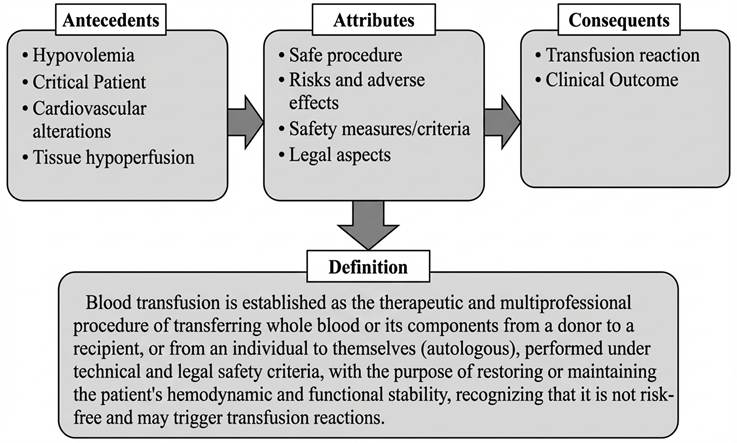
Therefore, the conceptual definition constructed establishes: blood transfusion is a therapeutic and multiprofessional procedure for transferring whole blood or its components from a donor to a recipient, or from an individual to themselves (autologous), performed under technical and legal safety criteria, with the purpose of restoring or maintaining the patient's hemodynamic and functional stability, recognizing that it is not risk-free and may trigger transfusion reactions.
Background and consequences
After analyzing the uses of the concept of blood transfusion in nursing, the antecedents and consequences present in the studies analyzed were identified and summarized in Figure 1.
The clinical antecedents, also called etiological factors, were classified according to the reference by Lopes, Silva, and Herdman(28). Considering that clinical antecedents can influence the causality of processes in different ways, the following definitions are used: the predisposing factor, which creates a state of susceptibility; the incapacitating factor, which interferes with recovery or health promotion; the precipitating factor, which initiates the causal chain; and the reinforcing factor, which amplifies the effect of an existing condition. Clinical consequences correspond to the clinical indicators presented by patients, which arise or manifest as a result of the occurrence of the phenomenon under study(28).
To facilitate understanding of the causal relationships among the key concepts, an illustrative pictogram was developed, representing the essential attributes, antecedents, and clinical consequences found in the literature on blood transfusion, as shown in Figure 1.
Figure 1 - Illustrated pictogram
Source: Authors, 2025
DISCUSSION
The findings of this conceptual analysis show that the term "blood transfusion," although widely used in healthcare practice, still has heterogeneous use in the literature and at various levels of care, which weakens the terminological consistency necessary for nursing. The absence of a standardized definition has a direct impact on transfusion safety, clinical decision-making, and the nurse's ability to conduct evidence-based practices. Thus, a more structured concept strengthens the nurse's autonomy, qualifies decision-making processes, and supports the development of essential skills for safe transfusion care.
The central attributes incorporated into the definition stand out as differentiators in the study, especially “safe procedure” and “safety criteria,” which are aligned with the requirements of ANVISA RDC No. 34/2014(29). These elements encompass steps such as correct patient identification, donor-recipient compatibility assessment, maintenance of storage conditions, and continuous monitoring. The explicit mention that this is a procedure performed under technical and legal safety criteria highlights the articulation of the concept with current regulatory requirements.
Another relevant element refers to risk factors, which include performing transfusions in an indiscriminate manner, capable of exposing the recipient to complications ranging from allergic or hemolytic reactions to the transmission of diseases such as syphilis, malaria, Chagas disease, and AIDS(30). This aspect corresponds to the attribute "risks and adverse effects" and the consequent "transfusion reaction" broadening the understanding of the vulnerabilities inherent in the process. The presence of the consequent "clinical outcome" reinforces, however, that the rigorous adoption of technical protocols has the potential to promote significant clinical improvement, which makes transfusion an essential therapeutic resource in various scenarios, as pointed out by the identified antecedents.
The conceptual clarification obtained also has direct implications for clinical practice, as it provides a consistent theoretical basis for the design of protocols, competencies, and nursing diagnoses related to blood transfusion. The integration of clinical antecedents and consequences allows for a broader view of the phenomenon, supporting the construction of assessment tools, realistic simulation scenarios, and pedagogical strategies aimed at the early recognition of adverse reactions and indication criteria. The concept developed favors advances in evidence-based practice and reinforces the critical role of nurses in the prevention of adverse events and the safe management of care. Furthermore, the results open perspectives for future studies that operationally validate the concept and explore its applicability in contexts such as tertiary care, emergencies, critical care units, and advanced therapies.
As for limitations, it was observed that the studies found in the literature that provide a definition of blood transfusion do not aim to present a comprehensive conceptualization or seek a conceptual reformulation of transfusion practice. Consequently, the scarcity of studies of this nature meant that the current analysis did not have a database conducive to a broad discussion of the concept analyzed.
CONCLUSION
The application of the proposed method made it possible to identify the essential characteristics of the concept of blood transfusion in nursing. Based on its conduct, it was possible to understand and structure the essential attributes, model and contrary cases, antecedents and consequences of the concept, as well as a clear and comprehensive conceptual definition, qualifying nursing care.
Based on this analysis, new paths are outlined for research that seeks to deepen the understanding of blood transfusion in different clinical and educational contexts, since the precise definition and adequate structuring of the concept expand its applicability as a variable in future studies. Thus, this conceptual evolution will contribute to evidence-based nursing practice, strengthening actions aimed at transfusion safety, the qualification of care, and the improvement of the skills necessary for professional practice.
REFERENCES
(1) Cava ÂM. Comparative Analysis of Students in Nursing Performance on Transfusion Safety. Rev Pesq Cuidado é Fundamental Online. 2021; 13:1519-25. https://doi.org/10.9789/2175-5361.rpcfo.v13.10261
(2) Shi Y, Ye C, Wang H, Cao D, Liu M, Xu J, Yang R, Shen L, Liu G, Zhai X. The Impact of a Closed-Loop Electronic Blood Transfusion System on Transfusion Errors and Staff Time in a Children’s Hospital. Transfusion Clinique Biologique. 2022; 29 (3):250-52. https://doi.org/10.1016/j.tracli.2022.03.004.
(3) Mohd Noor NH, Saad NH, Khan M, Hassan MN, Ramli M, Bahar R, Mohamed Yusoff S, Iberahim S, Wan Ab Rahman WS, Zulkafli Z, Islam MA. Blood Transfusion Knowledge among Nurses in Malaysia: A University Hospital Experience. Int J Environ Res Public Health. 2021; 18 (21): 11194. https://doi.org/10.3390/ijerph182111194.
(4) Dülger G, Okuroglu GK. Development of Safe Blood Transfusion Self‐Efficacy Scale for Nurses: Validity and Reliability Study. Transfusion and Apheresis Science. 2024; 63 (5): 103984. https://doi.org/10.1016/j.transci.2024.103984.
(5) Smith CM. CE: Recognizing Transfusion-Associated Circulatory Overload. AJN, Am J Nursing 2023; 123 (11):4-41. https://doi.org/10.1097/01.NAJ.0000995356.33506.f5.
(6) Dzik S. James Blundell, Obstetrical Hemorrhage, and the Origins of Transfusion Medicine. Transfus Med Rev. 2018; 32 (4): 205-12. https://doi.org/10.1016/j.tmrv.2018.08.003.
(7) Bertsch T, Lüdecke J, Antl W, Nausch L. Karl Landsteiner: The Discovery of the ABO Blood Group System and Its Value for Teaching Medical Students. Clin Lab. 2019; 65 (06). https://doi.org/10.7754/Clin.Lab.2018.181218.
(8) Oyekan F, McAleese H, Ahmed M, Booth C, Bowles L, Murphy MF, Tomini F, Green L, McCullagh J. Quantifying Harms Associated With Red Cell ABO Incompatible Blood Transfusion: A Systematic Review of the UK SHOT Literature. Transfus Med Rev. 2025; 39 (3):150906. https://doi.org/10.1016/j.tmrv.2025.150906.
(9) Soares FMM, Dutra SVO, Lima GK, Rodrigues ABFL, Magalhães DS, Negri EC. et al. Development and Content Validation of a Nursing Clinical Simulation Scenario on Transfusion Reaction Management. Int J Environ Res Public Health. 2024; 21 (8):1042. https://doi.org/10.3390/ijerph21081042.
(10) Simsek AK, Ecevit Alpar S, Cayli N. Nurses’ Self-Efficiency Levels in Safe Blood and Blood Component Transfusion: The Case of Turkey. Transfusion and Apheresis Science. 2024; 63 (3): 103888. https://doi.org/10.1016/j.transci.2024.103888.
(11) HEMOBR. Analysis of Blood Transfusions in the Brazilian Public Health System (SUS): Analytical Report of Hospital Transfusions in 2024 [Internet]. [accessed 2025 Jul 9]. Available online: https://www.hemobr.com/transfusãosus.
(12) Mattia D, Schneider DG, Gelbcke FL, Ferreira MMF, Paladini EP, Santos JLG et al. Construction and Validation of Indicators for Nursing Management in Blood Transfusion. Rev Bras Enferm. 2025; 78 (3). https://doi.org/10.1590/0034-7167-2024-0229.
(13) Rodrigues ABFL, Ozorio Dutra SV, dos Santos MIT, Araujo LR, Ferreira ALH, Jacinto AF et al. The Effects of the Clinical Simulation of Transfusion Reactions on Nursing Students’ Knowledge Gain: A Pragmatic Clinical Trial. Educ Sci (Basel). 2025; 15 (6): 693. https://doi.org/10.3390/educsci15060693.
(14) Kadıoğlu Ş, Tosun B. The Effectiveness of Safe Blood and Blood Products Transfusion Training for Intensive Care Nurses. Yoğun Bakım Hemşireliği Dergisi. 2024; 28 (3):181-94. https://doi.org/10.62111/ybhd.1497103.
(15) Igreja MJF. Safe Transfusion of Blood Components in the Emergency Department: Nurses’ Practices. Master’s Thesis, School of Health, Polytechnic Institute of Viana do Castelo, Viana do Castelo, 2023.
(16) Walker LO, Avant KC. Strategies for Theory Construction in Nursin. 6th ed. Pearson: Upper Saddle River; 2019.
(17) Page MJ, McKenzie JE, Bossuyt PM, Boutron I, Hoffmann TC, Mulrow CD et al. The PRISMA 2020 Statement: An Updated Guideline for Reporting Systematic Reviews. BMJ 2021, n71. https://doi.org/10.1136/bmj.n71.
(18) Oliveira C, Jacinto A, Neves H, Rodrigues AB, Junior F, Soares F. Analysis of the concept of transfusion reaction for nursing. Rev Enferm Atual In Derme. 2025; 99.
(19) Santo LX, Santana CCAP, Oliveira ASB. Hemotransfusion under the Perspective of Nursing Care. Rev Pesq Cuidado é Fundamental Online. 2021;65-71. https://doi.org/10.9789/2175-5361.rpcfo.v13.7458.
(20) Your Health. Blood transfusion: what it is, when it is necessary, and how it is done [Internet]. [accessed 2025 Feb 16]. Available online: https://www.tuasaude.com/em-que-situacoes-e-indicada-a-transfusao-de-sangue.
(21) Dr. Marcel Brunetto. Blood Transfusion - Learn About the Types and When It Is Necessary. [accessed 2025 Feb 16]. Available online: https://drmarcelbrunetto.com.br/transfusao-de-sangue/.
(22) Mundo Educação. Blood Transfusion. [accessed 2025 Feb 16]. Available online: https://mundoeducacao.uol.com.br/biologia/transfusao-sangue.htm.
(23) Monteiro LAS, Duarte ACG, Mota GAR, Correa RD, Santos FBO, Almeida SP. Donor Selection In Hemotherapy Services: Challenges Faced By The Patient Care Team In The Clinical Triage Process. REME-Rev Mineira Enfermagem. 2021; 25 (1). https://doi.org/10.5935/1415.2762.20210006.
(24) Oliveira VA, De Figueiredo VLM, Meira MA, Radtke MEB, Thofehrn MB. Nursing Staff Knowledge About Transfusion Therapy and Blood Safety. UFJF Nursing J. 2023; 9(1). https://doi.org/10.34019/2446-5739.2023.v9.39431.
(25) De Araújo Silva Vieira CM, Da Costa Carbogim F, Ganzella Sisdelli M, Hallack Neto AE, Nunes dos Reis V, Borges dos Santos K. Construction and Validation of an Instrument for Safe Transfusion Practice. Rev Pesq Cuidado é Fundamental Online. 2025; 17. https://doi.org/10.9789/2175-5361.rpcfo.v17.13326.
(26) Domaradzki J, Głodowska K, Jabkowski P. Between Autonomy and Paternalism: Attitudes of Nursing Personnel Towards Jehovah’s Witnesses’ Refusal of Blood Transfusion. Int J Public Health. 2023; 68. https://doi.org/10.3389/ijph.2023.1606291.
(27) Aloweni F, See MTA, Ng XP, Ang SY. Employing Serious Game for Assessing Knowledge of Blood Transfusion Procedure among Nurses: A Qualitative Evaluation and Feedback Improvement Study. Nurse Educ Today. 2021;101:104873. https://doi.org/10.1016/j.nedt.2021.104873.
(28) de Oliveira Lopes MV, da Silva VM, Herdman TH. Causation and Validation of Nursing Diagnoses: A Middle Range Theory. Int J Nurs Knowl. 2017; 28(1): 53–59. https://doi.org/10.1111/2047-3095.12104.
(29) National Health Surveillance Agency (ANVISA). Resolution - RDC No. 34, of june 11, 2014. Available online: https://saude.rs.gov.br/upload/arquivos/carga20170553/04145350-rdc-anvisa-34-2014.pdf (accessed on April 30, 2025).
(30) Vaillant A, Zubair M, Sticco K. Transfusion-Transmitted Disease. StatPearls [Internet]. Treasure Island (FL): StatPearls Publishing; 2024 Mar 20. [accessed 2025 Feb 16]. Available online: https://www.ncbi.nlm.nih.gov/books/NBK538427/.
Funding
This research received no external funding.
Use of Artificial Intelligence
AI or AI-assisted tools were not used in drafting any aspect of this manuscript.
Conflicts of Interest
The authors declare no conflicts of interest.
Data Availability Statement
No databases were generated in this study. The information presented is described in the body of the article.
Authorship Criteria (Authors' Contributions):
Conceptualization, F.M.M.S.; methodology, F.M.M.S.; software, F.M.M.S.; validation, F.M.M.S.;
formal analysis, F.M.M.S.; investigation, F.M.M.S.; resources, F.M.M.S.; data curation, F.M.M.S.;
writing - preparation of the original draft, F.M.M.S.; writing - revision and editing, A.R.B, B.S.d.C., C.H.F.d.A, L.L.d.O, L.d.S.S.Q and L.F.d.A.S; visualization, F.M.M.S.; Supervision, F.M.M.S.; Project administration, F.M.M.S.
All authors have read and agreed to the published version of the manuscript.
Rev Enferm Atual In Derme 2026;100(2): e026037