THERAPEUTIC APPROACHES FOR DIAPER DERMATITIS IN INFANTS: AN INTEGRATIVE
LITERATURE REVIEW
ABORDAGENS TERAPÊUTICAS PARA DERMATITE POR
FRALDAS EM LACTENTES: UMA REVISÃO INTEGRATIVA DA LITERATURA
ENFOQUES
TERAPÉUTICOS PARA LA DERMATITIS DEL PAÑAL EN LACTANTES: UNA REVISIÓN
INTEGRADORA DE LA LITERATURA
https://doi.org/10.31011/reaid-2026-v.100-n.3-art.2787
Maryanna
de Andrade Ferrari¹
Weverson
Ferrari Junior²
Tarcisio
Vitor Augusto Lordani³
¹Enfermeira.
Residente do programa de Gerenciamento de Enfermagem em Clínica Médica e
Cirúrgica no Hospital Universitário do Oeste do Paraná – HUOP. Cascavel, PR,
Brazil. ORCID: https://orcid.org/0009-0007-3536-5519
²Acadêmico.
Bacharel em Medicina na Universidade Estadual do Oeste do Paraná - Unioeste.
Cascavel, PR, Brazil. ORCID: https://orcid.org/0009-0008-4965-778X
³Enfermeiro.
Doutor em Biociências e Fisiopatologia, docente do Curso de Enfermagem na
Universidade Estadual do Oeste do Paraná – Unioeste. Cascavel, PR, Brazil.
ORCID: https://orcid.org/0000-0002-9997-6809.
Corresponding
Author
Maryanna
de Andrade Ferrari
Rua
Potiguaras, 1179, Santo Onofre. CEP 85806-430. Cascavel, PR, Brazil. Contato: +55(46)99908-4739,
E-mail: maryannaredacoes@gmail.com
Submission: 14-04-2026
Approval:
08-09-2026
ABSTRACT
Objectives: To
identify the most commonly used and effective treatments for diaper rash in
children aged 0 to 2 years, highlighting protocols for protecting and caring
for the skin barrier. Method: An integrative literature review was carried out
in six stages, according to Mendes et al. (2008), including study selection and
synthesis of results. The search, conducted between September and December 2023
in the MEDLINE/Pubmed, CINAHL, SCOPUS, and Web of Science databases, used
descriptors such as “Diaper Rash” and “Therapeutics”. Primary studies with
different designs, narrative reviews, and a practical guide in Portuguese,
English, or Spanish that addressed children aged 0 to 2 years with diaper rash
were included. Results: Of the 169 studies identified, 22 met the inclusion
criteria. Skin barriers (zinc oxide, petrolatum), topical corticosteroids, and
preventive practices such as adequate hygiene and friction reduction were the
most effective treatments. Breast milk demonstrated high efficacy in healing.
However, the indiscriminate use of corticosteroids has led to adverse effects,
and gaps in randomized studies persist. Conclusion: Diaper rash is
multifactorial and preventable. Standardized protocols focused on effective and
low-cost therapies are essential to improve clinical practice, promote skin
barrier recovery, and prevent complications.
Keywords: Diaper
Rash; Infant; Wound Healing.
RESUMEN
Objetivos:
Identificar los tratamientos más utilizados y efectivos para la dermatitis del
pañal en niños de 0 a 2 años, destacando los protocolos para proteger y cuidar
la barrera cutánea. Método: Se realizó una revisión integradora de la
literatura en seis etapas, según Mendes et al. (2008), incluyendo selección de
estudios y síntesis de resultados. La búsqueda, realizada entre septiembre y
diciembre de 2023 en las bases de datos MEDLINE/Pubmed, CINAHL, SCOPUS y Web of
Science, utilizó descriptores como “Diaper Rash” y “Therapeutics”. Se
incluyeron estudios primarios con diferentes diseños, revisiones narrativas y
una guía práctica, en portugués, inglés o español, que abordaran niños de 0 a 2
años con dermatitis del pañal. Resultados: De los 169 estudios identificados,
22 cumplieron los criterios de inclusión. Las barreras cutáneas (óxido de zinc,
vaselina), los corticosteroides tópicos y las prácticas preventivas como la
higiene adecuada y la reducción de la fricción fueron los tratamientos más
eficaces. Se ha demostrado que la leche materna es muy eficaz en la curación.
Sin embargo, el uso indiscriminado de corticosteroides ha generado efectos
adversos y persisten lagunas en los estudios aleatorizados. Conclusión: La dermatitis
del pañal es multifactorial y prevenible. Los protocolos estandarizados,
centrados en terapias efectivas y de bajo costo, son esenciales para mejorar la
práctica clínica, promover la recuperación de la barrera cutánea y evitar
complicaciones.
Palabras clave: Dermatitis del
Pañal; Lactante; Cicatrización de Heridas.
INTRODUCTION
Diaper dermatitis
is one of the most common dermatologic conditions in infancy. It can cause
considerable discomfort and may predispose infants to secondary infections,
although irritant contact dermatitis is the most frequent underlying form, as
noted by Ravanfar et al.1 Nourbakhsh et al.2 further
reported that peak incidence occurs between 6 and 12 months of age.
According to Ward
et al.3, diaper dermatitis accounts for more than one million
medical visits each year in the United States. Benitez Ojeda and Mendez4
reported that, when the diagnosis is accurate and appropriate management is
instituted promptly, the prognosis is excellent and the condition is generally mild
and self-limiting. In a cross-sectional study of 1,153 participants using
structured questionnaires, Sukhneewat et al.5 found a prevalence of
36.1%, which decreased significantly with age. Risk factors significantly
associated with diaper dermatitis in both univariate and multivariate analyses
included changing diapers fewer than three times during the night, a history of
previous episodes of diaper rash, use of cloth diapers, and topical application
of talcum powder to the diaper area.
Fernandes et al.6
observed that diaper use increases local temperature and moisture, making the
skin more susceptible to irritation from prolonged contact with urine and feces
and resulting in skin maceration. Secondary infection may also occur,
particularly with Candida albicans or bacteria such as Bacillus faecalis,
Proteus, Pseudomonas, Staphylococcus, and Streptococcus.
According to
Tüzün et al.7, friction is an important contributor to diaper
dermatitis, although it is not the sole factor. Increased hydration within the
diaper area weakens epidermal barrier function, produces a more fragile skin
surface, increases susceptibility to microorganisms, and amplifies the effects
of irritants present in urine and feces.
Hertiš Petek et
al.8 suggested that interleukin-1 alpha (IL-1α) is one of the main
drivers of inflammation in diaper dermatitis, as infants with diaper rash and
erythema show significantly higher IL-1α levels than healthy infants.
In line with
Hertiš Petek et al.8, preservation of the skin acid mantle is
important because it creates an environment that is unfavorable to colonization
by pathogenic microorganisms. An acidic skin pH of approximately 4.0-4.5 helps
maintain resident bacterial flora on the skin and thereby contributes to its
protective function. By contrast, an alkaline pH of approximately 8.0-9.0
promotes disruption of the cutaneous environment. Ammonia-induced
alkalinization also activates fecal enzymes such as lipase and trypsin, leading
to irritation and breakdown of the skin barrier.
According to Fernandes
et al.6, primary irritant diaper dermatitis is the most prevalent form. It is
characterized by confluent, shiny erythematous lesions whose intensity may vary
over time. Erythematous papules may be accompanied by edema and mild scaling
and typically affect areas with the greatest diaper contact, producing the
characteristic “W-shaped” distribution. The convex surfaces of the buttocks and
thighs, lower abdomen, pubic region, labia majora, and scrotum are most
commonly affected, while the skin folds are usually spared.
Hebert9
noted that modern topical agents, including corticosteroids and antimicrobials,
are widely used to treat diaper dermatitis because of their potent and rapid
effects. However, inappropriate, excessive, or prolonged use may cause adverse
effects such as skin atrophy, pigmentary changes,
hypothalamic-pituitary-adrenal axis suppression, and bacterial resistance,
thereby undermining the potential benefits of treatment.
Based on this
background, the research question was: What evidence has been reported in the
literature regarding the most commonly used and effective treatments for diaper
dermatitis in children aged 0-2 years?
OBJECTIVE
This study aimed
to identify the most commonly used and effective treatments for diaper
dermatitis in children aged 0-2 years and to describe their application
protocols in relation to protection and care of the skin barrier.
METHODS
Study design and period
This integrative
literature review followed the framework described by Mendes et al.10,
which comprises six stages: (1) identification of the topic and formulation of
the hypothesis or research question; (2) establishment of inclusion and
exclusion criteria and literature searching; (3) definition of the information
to be extracted from the selected studies; (4) appraisal of the included
studies; (5) interpretation of the results; and (6) synthesis of knowledge.
Search strategy
The search was
guided by the question: “What evidence has been reported in the literature
regarding the most commonly used and effective treatments for diaper dermatitis
in children aged 0-2 years?” The question was structured according to the PICo
mnemonic described by Munn et al.11, representing Population, Interest, and
Context: P - children aged 0-2 years; I - effectiveness of the most commonly
used treatments for diaper dermatitis; and Co - application protocols.
The searches were
conducted from September to December 2023 in MEDLINE/PubMed, CINAHL (Cumulative
Index to Nursing and Allied Health Literature), Scopus, and Web of Science.
English-language descriptors were combined using advanced search forms adapted
to the specifications of each database and the Boolean operators AND and OR.
Inclusion criteria
Eligible studies
were published in English, Spanish, or Portuguese, available in full text, and
without restriction on publication date. Primary studies of different designs,
narrative reviews, and practical guidance were included provided that they
addressed children aged 0-2 years with diaper dermatitis and described preventive,
management, or treatment measures.
Exclusion criteria
Incomplete
articles, letters, interviews, duplicates, studies involving other age groups,
studies that did not address diaper dermatitis in children or that focused on
other types of dermatitis, systematic or integrative reviews, and editorials
were excluded.
RESULTS
Literature search
A literature search was conducted in
MEDLINE/PubMed, CINAHL, Scopus, and Web of Science (Table 1). The search
strategy was based on the terms ((“Diaper Rash”) AND (Therapeutics)) AND
(Newborn).
Table 1 - Summary of the search process
|
Database
|
Search terms
|
Records identified
|
Records selected
|
Final sample
|
|
N
|
N
|
N
|
|
Pubmed/Medline
|
Diaper
Rash AND Therapeutics AND Newborn
|
102
|
32
|
17
|
|
Cinahl
|
31
|
12
|
2
|
|
Scopus
|
36
|
5
|
3
|
|
Web
of Science
|
0
|
0
|
0
|
|
Total
|
169
|
49
|
22
|
Source: Research data.
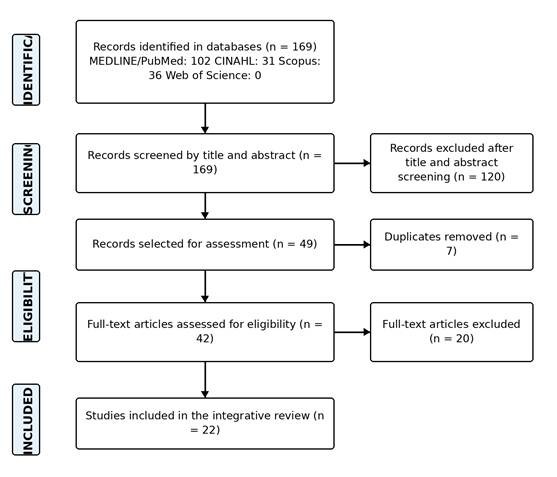
A total of 169
potentially eligible records were identified: 102 in MEDLINE/PubMed, 31 in
CINAHL, 36 in Scopus, and none in Web of Science. Titles and abstracts were
screened according to the inclusion criteria described above. Records
addressing topics outside the scope of the review, articles unavailable in full
text through the CAPES Journal Portal, and records meeting explicit exclusion
criteria were excluded at this stage. Forty-nine studies were selected for
further assessment; seven duplicates were removed, leaving 42 articles for
full-text review. After full-text assessment and application of the eligibility
criteria, 20 studies were excluded and 22 comprised the final sample. During a
subsequent check of the original search, the same strategy retrieved one Web of
Science record published in 2024. Because this record was not available during
the predefined search period, which ended in December 2023, it was neither
counted nor included in the sample. The study selection process is shown in
Figure 1.
Figure 1 - Flow diagram
of the study selection process, adapted from PRISMA.
Source: Research data.
Characteristics of the included studies
The final sample
consisted of 22 articles, all published in English between 1999 and 2021. Table
2 presents only the 22 studies that met the inclusion criteria and comprised
the final sample. The 20 full-text articles that did not meet the eligibility
criteria were excluded and therefore are not shown in the table.
Study designs
Although
systematic and integrative reviews were excluded, narrative reviews were
retained because of their broad scope and absence of the methodological
delimitations characteristic of other review types. Other included designs
comprised clinical trials, cross-sectional studies, retrospective studies, case
series, clinical analyses, descriptive studies, and a practical guide.
Across the included designs, the
studies addressed skin and stratum corneum pathophysiology, sociodemographic
factors, predisposing conditions and risk factors, preventive measures,
therapeutic approaches, infant care practices, treatment-related costs, and
variations in clinical management among infants admitted to neonatal intensive
care units (NICUs).
DISCUSSION
The findings
indicate that elevated pH may result from fecal urease, which breaks down urea
when urine and feces mix. This process promotes irritation of the diaper-area
skin, disrupts the resident flora, and increases susceptibility to infection by
opportunistic microorganisms through pH imbalance.25 This mechanism
helps explain colonization by Candida albicans, Staphylococcus aureus, and Streptococcus
spp.18
In the context of
cutaneous immaturity and additional aggravating factors, preterm newborns have
a substantially less developed skin barrier than term newborns. The presence of
only a few layers of the stratum corneum limits protective function and
contributes to overhydration, skin maceration, and increased permeability of
the lipid barrier.27
Because prolonged exposure and
alkaline pH promote microbial colonization and disruption of the protective
barrier,18 excessive use of soaps should be avoided, and cleansing
should be performed without friction.27
In the
cross-sectional study by Adalat, Wall, and Goodyear,30 factors such
as the type of skin-cleansing agent and frequency of cleansing, previously
considered important etiologic factors, were not significantly associated with
diaper dermatitis. Oral candidiasis, however, has been described as a relevant
factor, and failure to identify it may contribute to recurrence of diaper
dermatitis.15,30 The role of routine oral mucosal examination in
infants with diaper dermatitis and the strength of this association therefore
remain uncertain.
With regard to
predisposing factors and therapeutic products, petrolatum was evaluated in the
randomized clinical trial by Alonso et al.27 Its use was not associated
with a statistically demonstrable protective effect. Likewise, differences in
the development of diaper dermatitis according to sex or gestational age were
not demonstrated; therefore, these factors could not be associated with
incidence in that study.27
Conversely,
antibiotic therapy was significantly associated with an increased risk of
diaper dermatitis. The use of 50% oral glucose, which acts as an osmotic agent
by drawing water into the intestinal lumen, may also produce more irritating
stools because of a greater enzymatic load. Stool frequency itself was also
identified as a risk factor.27
The included
studies addressed risk factors as well as preventive and therapeutic measures.
Phototherapy was also reported as a potentially protective factor.27
This finding may appear counterintuitive because infants undergoing
phototherapy may experience frequent episodes of diarrhea. One possible
explanation is that, during phototherapy, the skin may remain less occluded and
therefore less exposed to maceration. Further studies are needed to clarify
this association and to evaluate treatment response in relation to
hospitalization-related factors.
Among the interventions
evaluated, human breast milk was reported as a highly effective treatment and
was recommended for infants with clinical manifestations of diaper dermatitis.26
In the randomized clinical trial by Farahani, Ghobadzadeh, and Yousefi,26
no significant differences were observed in lesion size, inflammation, or
severe erythema when the breast-milk intervention was compared with the topical
comparator.
Evidence suggesting that
human breast milk may be as effective as topical 1% hydrocortisone for healing
diaper dermatitis26 supports its potential use as a low-cost
therapeutic option. Nevertheless, this approach is not equally available to all
infants, particularly in the care of preterm newborns, and feasibility must
therefore be considered when developing clinical protocols.
Given the need for well-defined
therapeutic approaches, one study evaluated potassium hydroxide (KOH)
preparation testing to differentiate C. albicans and dermatophytes from other
skin disorders.17 The findings highlighted persistent challenges in
clinical assessment and diagnosis.
Following assessment and
diagnosis, commonly used topical antifungal agents include nystatin,
miconazole, and clotrimazole.17 Although diagnostic testing may help
reduce unnecessary treatment and associated costs, accurate measurement and
control of the amount of antifungal medication used and the treatment regimen
remain difficult. This finding further supports the need for evidence-based
protocols adapted to current hospital practice.
In routine practice,
topical corticosteroids such as 0.5% or 2.5% hydrocortisone acetate may be
applied to affected areas twice daily. However, topical corticosteroids should
not be used for more than 2 weeks unless under dermatologic supervision.15
Occlusion and other characteristics of the diaper area can increase drug absorption
and potency, and cases of Cushing syndrome have been reported in infants after
excessive use of clobetasol, a class I superpotent topical corticosteroid.15
Because the appropriate
use of these agents depends on the clinical presentation and comprehensive
assessment, particularly when opportunistic infection is suspected, barrier
preparations and their constituent components have also been investigated as
preventive measures.
Among skin barrier products, zinc
oxide and petrolatum are used both to prevent and to treat diaper dermatitis by
forming a lipid film that protects the skin surface and supports the stratum
corneum.15 Skin preparation and protection should be considered at
every diaper change, with particular attention to friction reduction and
moisture management.
With respect to diaper
changing and moisture control, friction becomes an aggravating factor when
cleansing is excessive or when alcohol-containing products are used.15
The results show that
several treatment options are available for diaper dermatitis, but studies
comprehensively evaluating prevention and treatment remain limited.
Indiscriminate corticosteroid use may lead to systemic absorption of potent
steroids, which is enhanced in skin folds,18 and may contribute to
growth suppression in infants.
Further evidence is
therefore needed on low-cost therapies that are feasible for healthcare
institutions and are not constrained by substantial product-related risks. For
example, the effectiveness of topical vitamin A cannot be established because
of the lack of randomized clinical trials.18 In addition, no
evidence was identified regarding the use of low-level laser therapy for the
treatment of diaper dermatitis.
Although prevention is emphasized
in several studies, preventive practices are not yet consistently implemented.
This finding suggests the need to standardize and implement institutional
protocols that provide effective, feasible prevention and treatment strategies
for nursing practice.
FINAL CONSIDERATIONS
Based on the
evidence identified, diaper dermatitis is a common dermatologic condition with
a multifactorial etiology involving the interaction of moisture, changes in pH,
friction, prolonged contact with urine and feces, and potential colonization by
opportunistic microorganisms. The findings reinforce that prevention should be
an integral component of management, with particular attention to skin barrier
protection, gentle cleansing without excessive friction, moisture control, and
appropriate care during diaper changes.
Among the
therapeutic approaches identified, barrier preparations-particularly
formulations containing zinc oxide and petrolatum-were prominent, as were human
breast milk, topical corticosteroids, and antifungal agents in selected
clinical situations. Although several strategies have shown benefits,
heterogeneity among the studies and the risks associated with indiscriminate
use of certain medications, especially corticosteroids, underscore the need for
individualized care and evidence-based protocols.
The findings of
this review therefore support the importance of nursing practice in identifying
risk factors, implementing prevention, monitoring skin integrity, and providing
therapeutic measures appropriate to the infant’s clinical condition.
Standardization of institutional practices may contribute to safer, more
accessible, and more consistent care. However, important gaps remain in the
literature, particularly the limited availability of randomized clinical trials
that comprehensively evaluate intervention effectiveness, safety, time to
response, and cost. Further studies are needed to strengthen evidence-based
decision-making in clinical practice.
REFERENCES
1.
Ravanfar P, Wallace JS, Pace NC. Diaper dermatitis: a
review and update. Curr Opin Pediatr. 2012;24(4):472-9.
doi:10.1097/MOP.0b013e32835585f2.
2.
Nourbakhsh SMK, Rouhi-Boroujeni H, Kheiri M, Mobasheri
M, Shirani M, Ahrani S, et al. Effect of topical application of the cream
containing magnesium 2% on treatment of diaper dermatitis and diaper rash in
children a clinical trial study. J Clin Diagn Res. 2016;10(1):WC04-6.
3.
Ward DB, Fleischer AB Jr, Feldman SR, Krowchuk DP.
Characterization of diaper dermatitis in the United States. Arch Pediatr
Adolesc Med. 2000;154(9):943-6. doi:10.1001/archpedi.154.9.943.
4.
Benitez Ojeda AB, Mendez MD. Diaper dermatitis. In:
StatPearls [Internet]. Treasure Island (FL): StatPearls Publishing; 2023
[updated 2023 Jul 3; cited 2026 Aug 28]. Available from:
https://www.ncbi.nlm.nih.gov/books/NBK559067/
5.
Sukhneewat C, Chaiyarit J, Techasatian L. Diaper
dermatitis: a survey of risk factors in Thai children aged under 24 months. BMC
Dermatol. 2019;19:7. doi:10.1186/s12895-019-0089-1.
6.
Fernandes JD, Machado MCR, Oliveira ZNP. Quadro clínico
e tratamento da dermatite da área das fraldas: parte II. An Bras Dermatol.
2009;84:47-54.
7.
Tüzün Y, Wolf R, Bağlam S, Engin B. Diaper (napkin)
dermatitis: a fold (intertriginous) dermatosis. Clin Dermatol. 2015;33:477-82.
8.
Hertiš Petek T, Petek M, Petek T, Marčun Varda N.
Emerging links between microbiome composition and skin immunology in diaper
dermatitis: a narrative review. Children (Basel). 2022;9:112.
9.
Hebert AA. A new therapeutic horizon in diaper
dermatitis: novel agents with novel action. Int J Womens Dermatol.
2021;7:466-70.
10.
Mendes KDS, Silveira RCCP, Galvão CM. Revisão
integrativa: método de pesquisa para a incorporação de evidências na saúde e na
enfermagem. Texto Contexto Enferm. 2008;17:758-64.
11.
Munn Z, Stern C, Aromataris E, Lockwood C, Jordan Z.
What kind of systematic review should I conduct? A proposed typology and
guidance for systematic reviewers in the medical and health sciences. BMC Med
Res Methodol. 2018;18(1):5. doi:10.1186/s12874-017-0468-4.
12.
Munson KA, Bare DE, Hoath SB, Visscher MO. A survey of
skin care practices for premature low birth weight infants. Neonatal Netw.
1999;18(3):25-31. doi:10.1891/0730-0832.18.3.25.
13.
Price S. A practical guide to preventing and treating
nappy rash. Br J Midwifery. 2000;8(11):702-4. doi:10.12968/bjom.2000.8.11.8053.
14.
Ferrazzini G, Kaiser RR, Hirsig Cheng SK, Wehrli M,
Della Casa V, Pohlig G, et al. Microbiological aspects of diaper dermatitis.
Dermatology. 2003;206(2):136-41. doi:10.1159/000068472.
15.
Shin HT. Diagnosis and management of diaper dermatitis.
Pediatr Clin North Am. 2014;61:367-82.
16.
Gustin J, Bohman L, Ogle J, Fadayel G, Mitchell MC, Narendran
V, et al. Improving newborn skin health: effects of diaper care regimens on
skin pH and erythema. Pediatr Dermatol. 2021;38:768-74.
17.
Campbell J, MacConnell V, Sacco L, Zuill R, Bosque E.
Use of potassium hydroxide (KOH) test reduces antifungal medication
prescription for suspected monilial diaper dermatitis in the neonatal intensive
care unit: a quality improvement project. Adv Neonatal Care. 2019;19:3-10.
18.
Blume-Peytavi U, Kanti V. Prevention and treatment of
diaper dermatitis. Pediatr Dermatol. 2018;35 Suppl 1:s19-23.
doi:10.1111/pde.13495.
19.
Malik A, Witsberger E, Cottrell L, Kiefer A, Yossuck P.
Perianal dermatitis, its incidence, and patterns of topical therapies in a
level IV neonatal intensive care unit. Am J Perinatol. 2018;35:486-93.
20.
Yonezawa K, Haruna M, Matsuzaki M, Shiraishi M, Kojima
R. Effects of moisturizing skincare on skin barrier function and the prevention
of skin problems in 3-month-old infants: a randomized controlled trial. J
Dermatol. 2018;45:24-30.
21.
Amer M, Diab N, Soliman M, Amer A. Neonatal skin care:
what should we do? A four-week follow-up randomized controlled trial at Zagazig
University Hospitals. Int J Dermatol. 2017;56:1198-203.
22.
Goldman M, Lodhi I. A real-world evidence study
evaluating a treatment for nappy rash. Br J Nurs. 2016;25(8):432-9.
doi:10.12968/bjon.2016.25.8.432.
23.
Ersoy-Evans S, Akinci H, Doğan S, Atakan N. Diaper
dermatitis: a review of 63 children. Pediatr Dermatol. 2016;33(3):332-6.
doi:10.1111/pde.12860.
24.
Kayaoglu S, Kivanc-Altunay I, Sarikaya S. Diaper
dermatitis in infants admitted to social pediatrics health center: role of
socio-demographic factors and infant care. Indian J Pediatr. 2015;82(10):904-8.
doi:10.1007/s12098-015-1747-x.
25.
Klunk C, Domingues E, Wiss K. An update on diaper
dermatitis. Clin Dermatol. 2014;32:477-87.
26.
Farahani LA, Ghobadzadeh M, Yousefi P. Comparison of
the effect of human milk and topical hydrocortisone 1% on diaper dermatitis.
Pediatr Dermatol. 2013;30:725-9.
27.
Alonso C, Larburu I, Bon E, González MM, Iglesias MT,
Urreta I, et al. Efficacy of petrolatum jelly for the prevention of diaper rash:
a randomized clinical trial. J Spec Pediatr Nurs. 2013;18:123-32.
28.
Gozen D, Caglar S, Bayraktar S, Atici F. Diaper
dermatitis care of newborns human breast milk or barrier cream. J Clin Nurs.
2014;23(3-4):515-23. doi:10.1111/jocn.12047.
29.
Gunes T, Akin MA, Sarici D, Hallac K, Kurtoglu S,
Hashimoto T. Guaiazulene: a new treatment option for recalcitrant diaper
dermatitis in NICU patients. J Matern Fetal Neonatal Med. 2013;26(2):197-200.
doi:10.3109/14767058.2012.722711.
30.
Adalat S, Wall D, Goodyear H. Diaper
dermatitis-frequency and contributory factors in hospital attending children.
Pediatr Dermatol. 2007;24:483-8.
31.
Ratliff C, Dixon M. Treatment of
incontinence-associated dermatitis (diaper rash) in a neonatal unit. J Wound
Ostomy Continence Nurs. 2007;34(2):158-61; discussion 161-2.
doi:10.1097/01.WON.0000264828.88237.de.
Funding and Acknowledgments:
This study received no funding and was conducted on a
voluntary basis.
Data availability statement
No datasets were generated in this study. The information
presented is described in the body of the article.
Conflict of interest statement
"None to declare."
Authorship criteria (author contributions)
Maryanna de Andrade Ferrari (Lead Author):
Responsible for study conception, methodology, manuscript drafting, and
critical review.
Weverson Ferrari Junior (Author): Contributed to
data collection and analysis, as well as methodological review.
Tarcisio Vitor Augusto Lordani (Advisor):
Responsible for supervision, critical review, and final editing of the
manuscript.
Scientific Editor: Ítalo Arão Pereira Ribeiro.
ORCID: https://orcid.org/0000-0003-0778-1447
Rev Enferm Atual In Derme 2026;100(3): e026099