REPORT
REPORT
DEVELOPMENT OF A GUIDE FOR THE PREVENTION AND MANAGEMENT OF WOUNDS IN HOME CARE
ELABORAÇÃO DE GUIA PARA PREVENÇÃO E TRATAMENTO DE FERIDAS NA ATENÇÃO DOMICILIAR
ELABORACIÓN DE GUÍA PARA LA PREVENCIÓN Y TRATAMIENTO DE HERIDAS EN LA ATENCIÓN DOMICILIARIA
https://doi.org/10.31011/reaid-2026-v.100-n.2-art.2799
¹Anna Caroline Kruger Treichel
²Fernanda Sant’Ana Tristão
³Aline da Costa Viegas
4Júlia Pizarro Duarte
5Michele Rodrigues Fonseca
6Cibele Velleda dos Santos
7Maria Angélica Silveira Padilha
8 Jefferson Sales da Silva
¹Universidade Federal de Pelotas, Pelotas, Brazil. Orcid: https://orcid.org/0009-0002-0097-7180
²Universidade Federal de Pelotas, Pelotas, Brazil. Orcid: https://orcid.org/0000-0002-8355-0133
³Hospital Escola UFPel/Ebserh. Empresa Brasileira de Serviços Hospitalares. Brazil. Orcid: https://orcid.org/0000-0001-6134-0496
4Universidade Federal de Pelotas, Pelotas, Brazil. Orcid: https://orcid.org/0009-0009-3573-5780
5Universidade Federal de Pelotas, Pelotas, Brazil. Orcid: https://orcid.org/0000-0002-2251-3793
6Hospital Escola UFPel/Ebserh. Empresa Brasileira de Serviços Hospitalares. Brazil. Orcid: https://orcid.org/0000-0002-6559-1484
7Hospital Escola UFPel/Ebserh. Empresa Brasileira de Serviços Hospitalares. Brazil. Orcid: https://orcid.org/0000-0002-5048-343X
8Hospital Escola UFPel/Ebserh. Empresa Brasileira de Serviços Hospitalares. Brazil. Orcid: https://orcid.org/0000-0001-9692-0140
Corresponding Author
Michele Rodrigues Fonseca
Rua Gomes Carneiro nº1, 96010-610, Pelotas, Rio Grande do Sul, Brazil, contact: +55(53) 98423-7276, E-mail: michelerodrigues091992@gmail.com
Submission: 05-05-2026
Approval: 27-07-2026
ABSTRACT
Introduction: Wounds represent a significant health problem, especially in the context of population aging and the increasing prevalence of chronic diseases. These lesions require continuous and qualified care, particularly in Home Care. In this context, educational materials can support the standardization of care practices and clinical decision-making. Thus, this study aimed to report the experience of developing a guide for the prevention and treatment of wounds intended for a Home Care service of a teaching hospital in southern Brazil. Method: This is a descriptive study with a qualitative approach, characterized as an experience report. Results: The development of the guide occurred in five stages: situational diagnosis of the service, literature review, selection and organization of the content, development of the pedagogical structure, and production and layout of the material. The absence of standardized material for wound management in the home care context was identified. The guide was structured in progressive chapters, addressing the main types of wounds in Home Care, such as pressure injuries, incontinence-associated dermatitis, diabetic foot, and vascular ulcers, including definition, risk factors, clinical assessment, prevention, and treatment. Conclusion: The development of the guide proved to be a relevant strategy to support professional practice in Home Care, contributing to the standardization of care practices, improvement of care quality, and strengthening of patient safety.
Keywords: Wounds and Injuries; Home Care Services; Educational Technology.
RESUMO
Introdução: As feridas constituem um relevante problema de saúde, especialmente no contexto do envelhecimento populacional e do aumento das doenças crônicas. Essas lesões demandam cuidados contínuos e qualificados, particularmente na Atenção Domiciliar. Nesse cenário, materiais educativos podem apoiar a padronização das condutas e a tomada de decisão clínica. Assim, este estudo teve como objetivo relatar a experiência de elaboração de um guia para prevenção e tratamento de feridas destinado a um serviço de Atenção Domiciliar de um hospital de ensino do sul do Brasil. Método: Trata-se de um estudo descritivo, de abordagem qualitativa, caracterizado como relato de experiência. Resultados: O desenvolvimento do guia ocorreu em cinco etapas: diagnóstico situacional do serviço, revisão de literatura, seleção e organização dos conteúdos, desenvolvimento do roteiro pedagógico e produção e diagramação do material. Identificou-se a ausência de material padronizado para o manejo de feridas no contexto domiciliar. O guia foi estruturado em capítulos progressivos, contemplando os principais tipos de feridas na Atenção Domiciliar, como lesão por pressão, dermatite associada à incontinência, pé diabético e úlceras vasculares, incluindo definição, fatores de risco, avaliação clínica, prevenção e tratamento. Conclusão: A elaboração do guia configurou-se como estratégia relevante para apoiar a prática assistencial na Atenção Domiciliar, contribuindo para a padronização das condutas, qualificação do cuidado e fortalecimento da segurança do paciente.
Palavras-chave: Ferimentos e Lesões; Assistência Domiciliar; Tecnologia Educacional
RESUMEN
Introducción: Las heridas constituyen un importante problema de salud, especialmente en el contexto del envejecimiento poblacional y del aumento de las enfermedades crónicas. Estas lesiones requieren cuidados continuos y cualificados, particularmente en la Atención Domiciliaria. En este contexto, los materiales educativos pueden apoyar la estandarización de las conductas y la toma de decisiones clínicas. Así, este estudio tuvo como objetivo relatar la experiencia de elaboración de una guía para la prevención y tratamiento de heridas destinada a un servicio de Atención Domiciliaria de un hospital de enseñanza del sur de Brasil. Método: Se trata de un estudio descriptivo, de enfoque cualitativo, caracterizado como relato de experiencia. Resultados: El desarrollo de la guía se llevó a cabo en cinco etapas: diagnóstico situacional del servicio, revisión de la literatura, selección y organización de los contenidos, desarrollo de la estructura pedagógica y producción y diagramación del material. Se identificó la ausencia de material estandarizado para el manejo de heridas en el contexto domiciliario. La guía fue estructurada en capítulos progresivos, contemplando los principales tipos de heridas en la Atención Domiciliaria, como lesión por presión, dermatitis asociada a la incontinencia, pie diabético y úlceras vasculares, incluyendo definición, factores de riesgo, evaluación clínica, prevención y tratamiento. Conclusión: La elaboración de la guía se configuró como una estrategia relevante para apoyar la práctica asistencial en la Atención Domiciliaria, contribuyendo a la estandarización de las conductas, la cualificación del cuidado y el fortalecimiento de la seguridad del paciente.
Palabras clave: Heridas y Lesiones; Atención Domiciliaria; Tecnología Educativa.
INTRODUCTION
Wounds are characterized as tissue damage that compromises skin structure and results in a loss of function, stemming from a disruption in the continuity of cutaneous tissue. Managing these conditions poses a significant challenge for healthcare systems, as it involves various levels of care, including hospital services, long-term care facilities, and community-based assistance, with a particular emphasis on home care(¹).
Wounds can be understood both as diseases and as conditions associated with comorbidities; in their chronic form, they constitute a complex syndrome linked to multiple pathologies. Global estimates indicate that approximately 4% of the world's population suffers from chronic wounds, highlighting the magnitude and epidemiological significance of this issue(²).
Demographic shifts over recent decades, particularly the rapid aging of the population, have contributed to an increase in the incidence of chronic wounds. The global population aged 80 and older is projected to triple by 2050, reaching approximately 426 million people, a trend also observed in Brazil(³). Increased longevity is associated with a higher prevalence of chronic conditions and functional limitations; these factors foster the development of such lesions and negatively impact clinical outcomes and healthcare costs(4).
Although national studies on wound prevalence in Brazil remain scarce, local investigations underscore the significance of the problem. A study conducted in a Brazilian municipality estimated the prevalence of chronic wounds at 1.64 cases per 1,000 inhabitants, predominantly affecting individuals with a mean age of 66 and low levels of education, thereby indicating a link between these lesions, population aging, and unfavorable socioeconomic conditions(5).
Against this backdrop, demographic and epidemiological changes have propelled home care to the forefront as a strategic component of healthcare systems, particularly for the care of individuals with chronic conditions and wounds. In Brazil, this model of care contributes to the continuity of care, integration into Health Care Networks, and the optimization of hospital bed utilization (6). Home-based care frequently involves treating individuals with various types of wounds, such as pressure injuries, diabetic, venous, and arterial ulcers, as well as surgical wounds and soft-tissue infections, which require systematic assessment, individualized therapeutic planning, and ongoing monitoring (7).
Given the complexity of managing these conditions, it is essential to adopt standardized prevention and treatment strategies that enhance clinical decision-making and promote care safety (8). In this context, educational materials designed for home care professionals serve as important tools for disseminating practices based on technical-scientific knowledge, thereby contributing to the standardization of procedures and the improvement of care quality.
In light of the above, this study aims to report the experience of developing a wound prevention and treatment guide for a home care service linked to a teaching hospital in southern Brazil.
METHODS
This is a descriptive study with a qualitative approach, characterized as an experience report, conducted between February and August 2025. The study took place within the Home Care Service of a public teaching hospital in southern Brazil; this hospital is linked to the federal hospital management network and is part of the Unified Health System (SUS). Home care is delivered through institutional programs that provide continuous, multiprofessional assistance to individuals with varying levels of clinical complexity.
The experience involved a nursing faculty member, nurses from the Home Care Service, and a specialized skin care team from the public teaching hospital, as well as undergraduate and graduate nursing students who participated in various stages of developing the educational material.
This experience report did not require review by a Research Ethics Committee, as it did not involve the participation of individuals as research subjects, but was instead limited to describing organizational and educational processes carried out within the service. The study was authorized in advance by the institution via a letter of consent.
RESULTS
In this study, an educational guide focused on wound prevention and treatment within the context of home care was developed, aiming to improve the quality of care and support the standardization of clinical practices. The material was structured as a resource to support professional practice, compiling systematized guidelines based on technical-scientific evidence.
The guide’s development was grounded in a technological research perspective, as it resulted in a product applied to clinical practice and aimed at resolving healthcare delivery issues. In this context, the incorporation of care-related technologies in nursing contributes to improving work processes and supporting clinical decision-making within health services.
The guide was developed through five interrelated stages, as described by Sparapani et al. (9).
1. Situational assessment
The first stage consisted of a situational assessment of the home care service, aiming to identify needs related to the care of individuals with wounds. To this end, a document analysis was conducted on institutional protocols regarding the prevention and treatment of skin lesions. This included the Protocol for Pressure Injury Prevention in Hospitalized Adults, available via the institutional channels of the Brazilian Hospital Services Company (EBSERH) and the UFPel University Hospital, as well as internal documents from the services involved.
An exploratory analysis of these documents revealed gaps regarding the lack of standardized material specifically tailored to the home care context, highlighting the need for a practical guide aligned with the service's clinical requirements.
2. Literature review and document analysis
The second stage involved two complementary literature review strategies: narrative and integrative. The narrative review aimed to contextualize the topic, covering aspects of skin structure and function, integumentary system defense mechanisms, wound care fundamentals, the epidemiological landscape of skin lesions, and the organization of home care in Brazil, based on scientific publications, clinical guidelines, technical manuals, and institutional protocols.
The integrative review sought to synthesize evidence regarding the effectiveness of educational materials in enhancing the knowledge and practices of healthcare professionals in wound care. The guiding question was formulated using the PICO strategy, and studies published between 2015 and 2025 in Portuguese, English, or Spanish were included, totaling 21 articles.
The results showed a predominance of educational materials in digital formats, such as presentations, online classes, quizzes, and videos. The studies indicated that these resources contribute to enhancing technical and clinical knowledge, improving care practices, and reducing adverse outcomes—such as pressure injuries, thereby reinforcing their potential to improve the quality of care.
3. Selection and organization of content
The third stage involved selecting and organizing the guide's content based on the results of the situational assessment and literature reviews. Priority was given to the wound types most prevalent in the home care context, as described in international literature and observed in the service's actual clinical practice, including pressure injuries, incontinence-associated dermatitis, diabetic foot, venous ulcers, and arterial ulcers.
For each condition, the following aspects were addressed in a standardized manner: definition, etiology, risk factors, clinical assessment, home-based prevention measures, treatment, and practical guidelines for lesion management. The content structure aimed to ensure clarity, conciseness, and clinical applicability.
4. Development of the outline and pedagogical organization
The fourth stage focused on the pedagogical and visual organization of the material, which was structured into sequential thematic sections using clear language tailored to the target audience. To systematize the information, a summary chart was created to guide the guide's thematic progression.
Visual aids were incorporated to complement the text, including illustrations from open-access scientific image banks (Servier Medical Art, Bioart Source – National Institute of Allergy and Infectious Diseases, Freepik, and Shutterstock) as well as from educational materials, scientific articles, and technical manuals, all duly referenced.
Some illustrations were generated using artificial intelligence tools (ChatGPT, version 5.0, and Leonardo.ai) based on technical descriptions; these were subsequently validated and reviewed by two nurses experienced in wound assessment and treatment to ensure clinical appropriateness, conceptual accuracy, and educational utility. Photographic images depicting pressure injury prevention practices were also produced in the hospital's high-fidelity simulation laboratory, including images used for the material's cover. The selection of illustrations took into account technical accuracy, visual clarity, suitability for the target audience, and thematic relevance; the images were reviewed for graphic and pedagogical quality by nurses experienced in wound prevention and treatment, with the aim of ensuring the material's accessibility and effectiveness in the teaching-learning process.
5. Production and layout of the guide
The final stage involved the production and layout of the educational material, integrating text and visual elements in an organized manner to facilitate reading and practical use. The layout incorporated principles of instructional design and visual communication, addressing information hierarchy, readability, and graphic standardization(10).
Recommendations from the Guide for Developing Printed Educational Materials for People with Low Vision were also adopted to enhance the material's accessibility and usability(11). Although the target audience is not composed exclusively of people with visual impairments, incorporating universal design principles helps improve visual comfort and information comprehension, while also fostering the inclusion of workers with disabilities.
The material was initially organized using a word processor (Microsoft Word) and subsequently laid out on the Canva platform. The final version of the guide was produced following evaluation and adjustments made by the service's nurses and the supervising faculty member.
The resulting product was structured into three thematic chapters, organized progressively, integrating conceptual foundations, technical guidelines, and practical recommendations for the care of individuals with wounds in the home setting. The material was developed in both print and digital versions, allowing for access via computer and mobile phone. The final version of the guide comprises 106 pages and 51 illustrative images, used to complement the text, facilitate understanding of the information, and support healthcare professionals in the practical application of the guidelines.
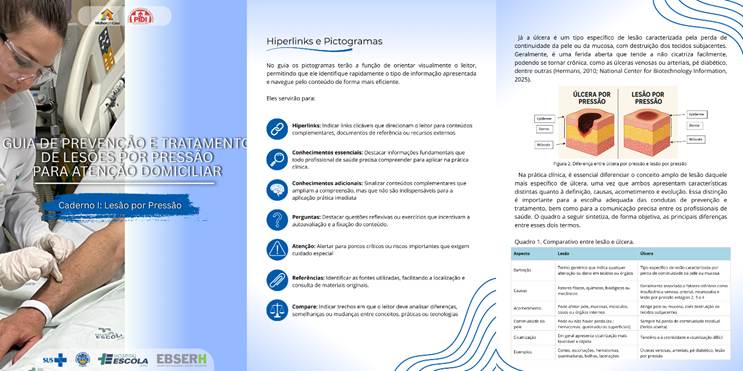
Subsequently, the guide was presented to the service's professionals at an institutional event, serving as an opportunity to share the material and engage in dialogue with the care teams. The document was then forwarded to the relevant institutional sectors for technical review, including evaluation by the coordinators of the services involved and the competent administrative departments, with the aim of obtaining institutional validation. Following this stage, the guide was approved by the institution and will be incorporated into the service's workflow of technical documents, as illustrated in Figure 1.
Figure 1 - Illustration of pages from the educational guide developed in this study, highlighting the material's graphic layout, the use of pictograms to guide the reader, and the integration of text, tables, and illustrations designed to support care practice in Home Care.
Source: Prepared by the authors.
DISCUSSION
A study identified that the prevalence of individuals with chronic wounds receiving home care increases significantly with age, reaching 2.5% among those aged 65 and older, highlighting the significance of this issue within the home care context. The results also demonstrated that care involves multiple health professionals, particularly nurses, medical specialists, and general practitioners—as well as frequent transitions between different services(12).
Another investigation revealed a high prevalence of pressure injuries (33.5%) among individuals receiving home care, particularly those under 75 years of age, those with low weight or normal body mass index, and those with a reduced level of consciousness, indicating greater vulnerability within this group(13). These findings reinforce the need for structured strategies to manage skin injuries in home care, aiming to improve the quality of care and support clinical decision-making.
In this context, the development of nursing technologies has emerged as a key strategy for enhancing the quality of care through the creation of tools, educational materials, protocols, and digital resources that support the standardization of practices and strengthen patient safety(14). The guide developed in this study aligns with this perspective, serving as an educational technology designed to support professional practice and the organization of work processes in home care.
Literature indicates that educational guides are effective strategies for supporting nursing care practice by fostering the systematization of actions, expanding professional knowledge, and aiding clinical decision-making, thereby contributing to the standardization of practices and the reduction of practice variability. However, incorporating evidence into care practice also depends on institutional factors, such as organizational culture, leadership support, and the adaptation of recommendations to the specific service context. Thus, guides aimed at health professionals serve as strategic resources for bridging the gap between scientific knowledge and care practice(15). The results of this study indicate that developing the guide served as a concrete strategy to bridge the gap between scientific knowledge and clinical practice. By translating and organizing content grounded in the literature, and adapted to the institutional reality of home care, the material facilitates the incorporation of recommendations into daily work routines and supports clinical decision-making.
Another relevant aspect concerns the use of visual aids and digital technologies in health education materials. Effective graphic layout, combined with principles of accessibility and universal design, enhances the understanding and usability of information, thereby facilitating the translation of scientific knowledge into guidelines applicable to everyday care(10). Thus, the developed guide also serves as a strategy to support continuing health education.
A limitation of this study is that the guide was developed within a single institutional setting, which may restrict the generalizability of the findings to other healthcare contexts. Furthermore, formal evaluations regarding the material's effectiveness on care outcomes or changes in professional behavior were not conducted at this stage. Future directions include conducting external validation studies, usability assessments, and analyses of the guide's impact on clinical practice and patient safety.
The developed guide shows potential for implementation in home care, as it aligns with care needs, current protocols, and the service's operational reality. Presenting it to professionals and submitting it for institutional review facilitates its incorporation into clinical practice. Broader validation and impact assessment could strengthen its adoption in other settings, contributing to improved care quality, standardized procedures, and enhanced patient safety and continuing health education.
CONCLUSION
The development of an educational guide for home care professionals highlighted the potential of nursing technologies to enhance the quality of wound prevention and treatment. By integrating scientific knowledge, institutional protocols, and clinical practice, the material serves as a resource to support decision-making, standardize procedures, and strengthen patient safety.
The organization of the content, combined with the use of visual aids and digital technologies, enhanced its usability and potential for continuing education. Its institutional presentation and submission for evaluation reinforce the feasibility of incorporating it into clinical practice.
The study demonstrates that developing evidence-based guides is a viable strategy for improving the quality of care, though further studies are needed to assess their impact and applicability in other contexts.
REFERENCES
1. Kangal Ö, Regan J. Wound healing phases. StatPearls [Internet]. Treasure Island (FL): StatPearls Publishing; 2023 [citado 2026 Abr 10]. Disponível em: https://www.ncbi.nlm.nih.gov/books/NBK470443/
2. Secco J, Spinazzola E, Pittarello M, Ricci E, Pareschi F. Clinically validated classification of chronic wounds method with memristor-based cellular neural network. Sci Rep. 2024;14:81521. doi: https://doi.org/10.1038/s41598-024-81521-9
3. United Nations. World Population Prospects 2022 [Internet]. New York: United Nations; 2022 [citado 2026 Abr 10]. Disponível em: https://population.un.org/wpp
4. Nieto-García L, Carpio-Pérez A, Moreiro-Barroso MT, Rubio-Gil FJ, Ruiz-Antúnez E, Nieto-García A, et al. Is the increase in record of skin wounds in hospitalized patients in internal medicine units a side effect of the COVID-19 pandemic? Int J Environ Res Public Health. 2023;20(3):2228. doi: 10.3390/ijerph20032228
5. Borges EL, Nascimento-Filho HM, Píres-Júnior JF. Prevalência de lesões crônicas em município da Zona da Mata Mineira (Brasil). Rev Min Enferm. 2018;22:e-1143. doi: 10.5935/1415-2762.20180074
6. Ministério da Saúde (BR). Atenção domiciliar na atenção primária à saúde [Internet]. Brasília-DF: Ministério da Saúde; 2020 [citado 2026 Abr 10]. Disponível em: https://bvsms.saude.gov.br/bvs/publicacoes/atencao_domiciliar_primaria_saude.pdf
7. Ministério da Saúde (BR). Caderno de atenção domiciliar [Internet]. Brasília-df: Ministério da Saúde; 2013 [citado 2026 Abr 10]. Disponível em: https://bvsms.saude.gov.br/bvs/publicacoes/caderno_atencao_domiciliar_melhor_casa.pdf
8. Melo da Silva W, dos Santos Cortez MJ, Henriques Brito MV, Lima Junior FA, Santos RS, Siqueira HGAS, et al. Estratégias terapêuticas para prevenção e tratamento de feridas crônicas e lesões cutâneas: uma revisão de literatura. Rev Enferm Atual In Derme. 2025;99(3):e025112. doi: https://doi.org/10.31011/reaid-2025-v.99-n.3-art.2576
9. Sparapani VC, Souza AIJ, Anders JC, Pina JC, Rocha PK. Modelo teórico-metodológico de elaboração e validação de tecnologia educacional para a área da Enfermagem. Rev Baiana Enferm. 2023;37:e54361. doi: 10.18471/rbe.v37.54361
10. Ministério da Saúde (BR). Manual de produção editorial voltado para as áreas técnicas do Ministério da Saúde [Internet]. Brasília-DF: Ministério da Saúde; 2024 [citado 2026 Abr 10].
11. Bueno J, Lima CR, Sanches ECP, Antoniolli KA, Reque M. Guia de recomendações para o desenvolvimento de materiais didáticos impressos para o público de baixa visão [Internet]. Curitiba: PPGDesign; 2022 [citado 2026 Abr 10]. Disponível em: https://ufpr.br/wp-content/uploads/2022/07/Guia-BV-ImpressoVersao-Lancamento-1.0.pdf
12. Alvarez-Irusta L, Van Durme T, Lambert AS, Macq J. People with chronic wounds cared for at home in Belgium: prevalence and exploration of care integration needs using health care trajectory analysis. Int J Nurs Stud. 2022;135:104349. doi: 10.1016/j.ijnurstu.2022.104349
13. Ramadan D, Metin Akten İ. Prevalence and risk factors of pressure injury in home care patients. Home Health Care Manag Pract. 2025;37(3):174-180. doi: 10.1177/10848223241282008
14. Lima FC, Sagica TDP, Souza JLM, Prado MLD, Santana ME, Peixoto IVP, et al. Profile of scientific production on nursing technology construction, validity and application: a bibliometric study. Rev Bras Enferm. 2024;77(3):e20230452. doi: 10.1590/0034-7167-2023-0452
15. Serra-López J, Miranda A, Soria A, López N, Castañón E, Majem M. Clinical practice guide for nurses that optimizes nurse's comprehensive care of patients undergoing immunotherapy. Enferm Clin (Engl Ed). 2025;35(6):502193. doi: 10.1016/j.enfcle.2025.502193
Article derived from an undergraduate nursing capstone project titled “Development of a Wound Prevention and Treatment Guide for the Home Care Service of a teaching hospital in Southern Brazil,” conducted at a public higher education institution in 2025.
Funding and Acknowledgments:
The research received no funding.
Data availability statement
No databases were generated in this study. The information presented is described in the body of the article.
Conflict of interest statement
None to declare.
Authorship criteria (author contributions)
1. Study conception and planning: Anna Caroline Kruger Treichel; Fernanda Sant’Ana Tristão; Aline da Costa Viegas
2. Data acquisition, analysis, and interpretation: Júlia Piarro Duarte; Cibele Velleda dos Santos; Maria Angélica Silveira Padilha; Jefferson Sales Silvaz
3. Drafting, critical review, and final approval of the published version: Anna Caroline Kruger Treichel; Fernanda Sant’Ana Tristão; Aline da Costa Viegas; Michele Rodrigues Fonseca; Júlia Piarro Duarte; Cibele Velleda dos Santos; Maria Angélica Silveira Padilha; Jefferson Sales da Silvaz
Scientific Editor: Ítalo Arão Pereira Ribeiro. ORCID: https://orcid.org/0000-0003-0778-1447
Rev Enferm Atual In Derme 2026;100(2): e026081