ORIGINAL ARTICLE
PERCEPTIONS OF NURSING PROFESSIONALS AND COMMUNITY MIDWIVES REGARDING HUMANIZATION DURING THE PREGNANCY-PUERPERIUM CYCLE
PERCEPÇÕES DE PROFISSIONAIS DE ENFERMAGEM E PARTEIRAS COMUNITÁRIAS SOBRE A HUMANIZAÇÃO NO CICLO GRAVÍDICO-PUERPERAL
PERCEPCIONES DE PROFESIONALES DE ENFERMERÍA Y PARTERAS COMUNITARIAS SOBRE LA HUMANIZACIÓN EN EL CICLO GRAVÍDICO-PUERPERAL
https://doi.org/10.31011/reaid-2026-v.100-n.4-art.2843
1José Augusto Chamolehã
2Emanuel Thomaz de Aquino Oliveira
3Girlene Ribeiro da Costa
4Lucas António Nhamba
5Rosilane de Lima Brito Magalhães
6Márcia Teles de Oliveira Gouveia
1Universidade Federal do Piauí, Teresina, Brazil. ORCID: https://orcid.org/0009-0002-9187-3888
2Universidade Federal do Piauí, Teresina, Brazil. ORCID: https://orcid.org/0000-0002-6289-130X
3Universidade Federal do Piauí, Teresina, Brazil. ORCID: https://orcid.org/0000-0002-0214-4601
4Governo da Província do Huambo, Huambo, Angola. ORCID: https://orcid.org/0000-0001-6092-625X
5Universidade Federal do Piauí, Teresina, Brazil. ORCID: https://orcid.org/0000-0001-9695-1350
6Universidade Federal do Piauí, Teresina, Brazil. ORCID: https://orcid.org/0000-0002-2401-4947
Corresponding Author
Emanuel Thomaz de Aquino Oliveira
Campus Ministro Petrônio Portella, Bairro: Ininga, Pós-Graduação em Enfermagem, Teresina, Piauí, Brazil. CEP: 64049-550. Phone: +55 (86) 3215-5558. e-mail: emanueloliveira@ufpi.edu.br
Submission: 02-07-2026
Approval: 21-10-2026
ABSTRACT
Introduction: humanization of care during the pregnancy-puerperium cycle involves respect, dignity, a welcoming approach, and consideration of women's sociocultural needs. Objective: to describe the perceptions of Nursing professionals and community midwives regarding humanization during the pregnancy-puerperium cycle. Method: mixed-methods, cross-sectional, descriptive study with sequential integration of components during data analysis and interpretation, conducted at the Bailundo Maternal and Child Health Center, Huambo, Angola. Participants included 53 Nursing professionals and 12 community midwives. Quantitative data were analyzed using descriptive statistics, and open-ended responses from both groups by lexical analysis in IRaMuTeQ software. Results: among Nursing professionals, 86.8% considered humanized care important and 49.1% reported lacking conditions to provide it. Among community midwives, 91.7% considered it important and 58.3% considered it possible at the place of birth. In the lexical analysis, the terms “care”, “condition”, “good”, and “lack” stood out among Nursing professionals, who associated humanization with working conditions and resource availability; midwives emphasized “staying”, “love”, “affection”, and “joyful”, relating to their presence and affection toward the woman during childbirth. Respect for women was common in both groups. Conclusion: both groups understood humanization in complementary ways: professionals as relational care conditioned by the service structure, and midwives as affective presence alongside the woman, with respect as a common basis. These findings point to the need for better working conditions and recognition of the care provided by midwives.
Keywords: Humanization of Assistance; Maternal Health; Nurse Professionals; Midwives.
RESUMO
Introdução: a humanização da assistência no ciclo gravídico-puerperal envolve respeito, dignidade, acolhimento e consideração das necessidades socioculturais da mulher. Objetivo: descrever as percepções de profissionais de Enfermagem e de parteiras comunitárias sobre a humanização no ciclo gravídico-puerperal. Método: estudo de métodos mistos, de delineamento transversal e descritivo, com integração sequencial dos componentes na análise e na interpretação dos dados, realizado no Centro Materno-Infantil do Bailundo, Huambo, Angola. Participaram 53 profissionais de Enfermagem e 12 parteiras comunitárias. Os dados quantitativos foram analisados por meio de estatística descritiva, e as respostas abertas dos dois grupos, por análise lexical no software IRaMuTeQ. Resultados: entre os profissionais de Enfermagem, 86,8% consideraram importante o atendimento humanizado e 49,1% relataram não dispor de condições para realizá-lo. Entre as parteiras comunitárias, 91,7% consideraram-no importante e 58,3% referiram ser possível aplicá-lo no local do parto. Na análise lexical, destacaram-se, entre os profissionais, os termos "atendimento", “condição”, “bom” e “falta”, os quais associaram a humanização às condições de trabalho e à disponibilidade de recursos; entre as parteiras, destacaram-se “ficar”, “amor”, “carinho” e “alegre”, relacionados à presença e ao afeto junto à mulher durante o parto. O respeito à mulher foi elemento comum aos dois grupos. Conclusão: os dois grupos compreenderam a humanização de modo complementar: os profissionais, como um cuidado relacional condicionado à estrutura do serviço; as parteiras, como uma presença afetiva junto à mulher, com o respeito como base comum. Esses achados apontaram para a necessidade de melhores condições de trabalho e de reconhecimento do cuidado oferecido pelas parteiras.
Palavras-chave: Humanização da Assistência; Saúde Materna; Profissionais de Enfermagem; Parteiras.
RESUMEN
Introducción: la humanización de la atención durante el ciclo embarazo-puerperio implica respeto, dignidad, aceptación y consideración de las necesidades socioculturales de las mujeres. Objetivo: describir las percepciones de los profesionales de enfermería y las parteras comunitarias respecto a la humanización durante el ciclo embarazo-puerperio. Método: estudio descriptivo, transversal y de métodos mixtos con integración secuencial de componentes en el análisis e interpretación de datos, realizado en el Centro Materno-Infantil Bailundo, Huambo, Angola. Participaron cincuenta y tres profesionales de enfermería y doce parteras comunitarias. Los datos cuantitativos se analizaron mediante estadística descriptiva, y las respuestas abiertas de ambos grupos se analizaron mediante análisis léxico en el software IRaMuTeQ. Resultados: entre los profesionales de enfermería, el 86,8% consideró importante la atención humanizada, mientras que el 49,1% informó carecer de las condiciones para proporcionarla. Entre las parteras comunitarias, el 91,7% la consideró importante y el 58,3% afirmó que era posible aplicarla en el lugar del parto. En el análisis léxico, los términos “cuidado”, “condición”, “bueno” y “falta” destacaron entre los profesionales, asociando la humanización con las condiciones laborales y la disponibilidad de recursos; entre las matronas, destacaron “permanencia”, “amor”, “afecto” y “alegría”, relacionados con la presencia y el afecto hacia la mujer durante el parto. El respeto por la mujer fue un elemento común en ambos grupos. Conclusión: los dos grupos entendieron la humanización de forma complementaria: los profesionales, como un cuidado relacional condicionado por la estructura del servicio; las matronas, como una presencia afectiva con la mujer, con el respeto como base común. Estos hallazgos señalaron la necesidad de mejores condiciones laborales y el reconocimiento del cuidado que brindan las matronas.
Palabras clave: Humanización de la Atención; Salud Materna; Enfermeras Practicantes; Partería.
INTRODUCTION
The humanization of healthcare consists of comprehensive care that recognizes feelings and concerns, establishes bonds of solidarity, and promotes individuals' autonomy and active participation in the decision-making process(1). The adoption of humanized professional practices in the context of the pregnancy-puerperium cycle makes it possible to value and respect each woman's individuality, as well as to alleviate the fears and uncertainties expressed throughout this period(2). In this sense, humanized healthcare for women must ensure care free from discrimination, guided by equity, respect for individual rights, and appreciation of sociocultural diversity(3).
Furthermore, addressing the pregnancy-puerperium cycle requires attitudes, behaviors, and knowledge that go beyond the reductionist perspective of the clinical model by recognizing its unique and multidimensional nature. This period encompasses the physical, emotional, and sociocultural dimensions in an inseparable manner(4). From this perspective, humanization in healthcare seeks to promote childbirth and birth processes while respecting the uniqueness of each experience. To this end, such practices must be continuously improved by Nursing professionals to strengthen bonds of trust, welcome, and respect(5).
In African contexts, the work of community midwives has historical roots and is among the traditional practices of maternal care. Their work involves supporting the childbirth process and providing physical and emotional support to women in labor, playing an important role in maternal healthcare, particularly in rural areas and locations where access to formal health services is limited(6).
In addition to access to healthcare services, women's choices regarding the place and type of childbirth care may be related to the trust established with midwives and the appreciation of traditional practices within their communities. In a study conducted in Ethiopia, the preference for home birth was associated with the distance to health services, transportation difficulties, the perception of disrespectful care in healthcare institutions, and the greater receptiveness of traditional birth attendants(7).
The incorporation of humanized practices into obstetric care is an important element in improving the quality of maternal and perinatal care. This approach goes beyond the application of technical and scientific knowledge and encompasses the appreciation of cultural and social dimensions and the dignity of pregnant women. Establishing therapeutic relationships based on respect for individual values and attention to the needs expressed by women is essential to a person-centered care relationship focused on their well-being(8).
Despite advances in research and maternal healthcare practices, challenges remain in incorporating humanization into the daily routine of obstetric services, particularly with regard to respect, dignity, and women's needs(8). Therefore, this study aimed to describe the perceptions of Nursing professionals and community midwives regarding humanization in the pregnancy-puerperium cycle.
METHOD
This was a mixed-methods, cross-sectional, descriptive study, with sequential integration of the quantitative and qualitative components during the data analysis and interpretation stages. The quantitative component was analyzed first. Subsequently, the open-ended responses were analyzed to further explore and contextualize the quantitative findings. Integration of the components took place during the results’ interpretation.
The study was conducted at the Bailundo Maternal and Child Health Center (CMIB), a referral facility in the municipality of Bailundo, located 75 kilometers north of the city of Huambo, the provincial capital of Huambo Province, Angola. The municipality has an estimated population of 82,024 women of reproductive age, with an estimated 4,265 pregnancies and 3,527 births per year.
Of the 57 Nursing professionals at the CMIB, 53 participated in the study (93.0%), including nurses and Nursing technicians who provided care to women during the pregnancy-puerperium cycle. A census approach was adopted, with no sample size calculation. Professionals with less than one year of experience at the facility and those who were absent for any reason or on vacation during the data collection period were excluded.
The municipality had 199 registered community midwives distributed across three communes. The sample was selected by convenience: 12 midwives who were scheduled to participate in guidance and training activities at the CMIB during the data collection period were invited to participate. The inclusion criteria were being present at the activities during data collection and providing consent to participate in the study. All 12 agreed to participate.
Data were collected between February and March 2023 using two structured, self-administered questionnaires developed by the researchers and pilot-tested before application: one intended for Nursing professionals and the other for community midwives. The instruments were administered according to the work schedules of eligible professionals and the presence of midwives at activities conducted at the CMIB.
The instruments were organized into two sections. The first covered sociodemographic and professional variables, including age, marital status, number of children, educational attainment, length of professional experience, participation in training, working conditions, and aspects of care practices. The second addressed aspects related to the importance of humanization, motivation, and the conditions for its implementation, as well as open-ended questions about participants' understanding of humanization during the pregnancy-puerperium cycle.
The questionnaires were completed in a private setting at the workplace, in the presence of the researcher, and participants were given the time needed to complete the instrument.
Quantitative data were analyzed using the Statistical Package for the Social Sciences (SPSS), version 25.0, through descriptive statistics, with absolute and relative frequencies for categorical variables and means and standard deviations for quantitative variables. Unanswered questions were reported as “no response” and included in the denominator when calculating percentages.
The open-ended responses from Nursing professionals (questions about their understanding of humanization and the factors influencing it) and community midwives were transcribed in full from the questionnaires and organized into two textual corpora, which were processed separately using identical parameters in the IRaMuTeQ software, version 0.8 alpha 7. During corpus preparation, expressions that reproduced the wording of the questions (for example, “humanization consists of” and “the factors that may influence it are”) were removed, while the content of the responses was fully preserved. The corpus of Nursing professionals comprised 50 texts (three questionnaires with no responses to the open-ended questions), with 1,320 occurrences, 328 distinct forms, and 171 hapax; the corpus of community midwives comprised 11 texts (one midwife did not answer the open-ended question; two responses in Umbundu were translated into Portuguese by the researcher), with 115 occurrences, 46 distinct forms, and 22 hapax. A word cloud was generated for each group to identify the most frequent terms. For the responses from Nursing professionals, a similarity analysis was also performed using the co-occurrence index and words with a frequency of six or more to visualize the relationships between terms. The results were interpreted in light of the discursive responses and integrated with the quantitative findings.
The discursive responses from both groups were interpreted based on the complementary conceptual framework provided by the guidelines of the Prenatal and Birth Humanization Program (PHPN), considering aspects related to a welcoming approach, respect, dignity, and the appreciation of women, without a normative intent for the Angolan context.
The study followed the principles of the Declaration of Helsinki and was conducted after institutional authorization and approval by the Ethics Committee of the Ministry of Health of Angola (MINSA), under approval No. 23 C.M/MINSA.INS/2023. Participants were informed in advance about the objectives of the research and, after agreeing to participate, signed the Free and Informed Consent Term, with anonymity guaranteed.
RESULTS
A total of 53 Nursing professionals and 12 community midwives participated in the study. The participants' characteristics are presented in Tables 1 and 2. The mean age was 35.1 years (SD = 8.5) among Nursing professionals and 57.3 years (SD = 9.4) among community midwives. Among Nursing professionals, most were single (77.4%), had completed secondary education (69.8%), and were Nursing technicians (79.2%); 39.6% had between one and four years of service. Among community midwives, 75.0% were aged 50 years or older, 83.3% had five or more children, and 91.7% had primary education as their highest level of educational attainment. The mean length of professional experience among community midwives was 27.2 years (SD = 5.6).
Table 1 – Sociodemographic profile of Nursing professionals at the Bailundo Maternal and Child Health Center and community midwives. Bailundo, Huambo, Angola, 2023.
|
Variables |
Nursing professionals |
Community midwives |
||
|
n=53 |
% |
n=12 |
% |
|
|
Age |
|
|
|
|
|
20-29 years |
17 |
32.1 |
- |
- |
|
30-39 years |
16 |
30.2 |
- |
- |
|
40-49 years |
16 |
30.2 |
2 |
16.7 |
|
≥ 50 years |
2 |
3.8 |
9 |
75.0 |
|
No response |
2 |
3.8 |
1 |
8.3 |
|
Marital status |
|
|
|
|
|
Single |
41 |
77.4 |
7 |
58.3 |
|
Married |
11 |
20.8 |
- |
- |
|
Widowed |
1 |
1.9 |
5 |
41.7 |
|
Number of children |
|
|
|
|
|
No children |
1 |
1.9 |
- |
- |
|
1-4 children |
19 |
35.8 |
2 |
16.7 |
|
≥ 5 children |
11 |
20.8 |
10 |
83.3 |
|
No response |
22 |
41.5 |
- |
- |
|
Education |
|
|
|
|
|
Primary education |
- |
- |
11 |
91.7 |
|
Secondary education |
37 |
69.8 |
- |
- |
|
Post-secondary education |
5 |
9.4 |
- |
- |
|
Bachelor's degree |
10 |
18.9 |
1 |
8.3 |
|
Postgraduate degree |
1 |
1.9 |
- |
- |
Note: - Numerical value equal to zero. Source: Research data, 2023.
Regarding the professional profile and working conditions (Table 2), 71.7% of Nursing Professionals reported being dissatisfied or very dissatisfied with their salaries, and 67.9% reported having participated in training sessions, seminars, or conferences. Among Community Midwives, 66.7% practiced with authorization from the Ministry of Health, and 50.0% did not have access to sterilized materials for home births.
Table 2 – Professional profile and work practices of Nursing Professionals at the Bailundo Maternal and Child Health Center and Community Midwives. Bailundo, Huambo, Angola, 2023.
|
Variables |
Nursing professionals |
Community midwives |
||
|
n=53 |
% |
n=12 |
% |
|
|
Professional category |
|
|
|
|
|
Nursing Technician |
42 |
79.2 |
— |
— |
|
Nurse |
11 |
20.8 |
— |
— |
|
Length of service |
|
|
|
|
|
1-4 years |
21 |
39.6 |
- |
- |
|
5-9 years |
5 |
9.4 |
- |
- |
|
10-14 years |
10 |
18.9 |
- |
- |
|
15-19 years |
10 |
18.9 |
- |
- |
|
≥ 20 years |
4 |
7.5 |
10 |
83.3 |
|
No response |
3 |
5.7 |
2 |
16.7 |
|
Participation in training courses, seminars, and/or conferences |
|
|
|
|
|
Yes |
36 |
67.9 |
— |
— |
|
No |
14 |
26.4 |
— |
— |
|
No response |
3 |
5.7 |
— |
— |
|
Salary satisfaction |
|
|
|
|
|
Very dissatisfied |
9 |
17.0 |
— |
— |
|
Dissatisfied |
29 |
54.7 |
— |
— |
|
Satisfied |
10 |
18.9 |
— |
— |
|
Very satisfied |
- |
- |
— |
— |
|
No response |
5 |
9.4 |
— |
— |
|
Satisfaction with work schedule |
|
|
|
|
|
Very dissatisfied |
5 |
9.4 |
— |
— |
|
Dissatisfied |
15 |
28.3 |
— |
— |
|
Satisfied |
27 |
50.9 |
— |
— |
|
Very satisfied |
4 |
7.5 |
— |
— |
|
No response |
2 |
3.8 |
— |
— |
|
Practice authorized by the Ministry of Health |
|
|
|
|
|
Yes |
— |
— |
8 |
66.7 |
|
No |
— |
— |
2 |
16.7 |
|
No response |
— |
— |
2 |
16.7 |
|
Sterilized materials for home births |
|
|
|
|
|
Yes |
— |
— |
5 |
41.7 |
|
No |
— |
— |
6 |
50.0 |
|
No response |
— |
— |
1 |
8.3 |
Notes: - Numerical value equal to zero. — Not applicable (variable not investigated in the group).
Source: Research data, 2023.
Table 3 summarizes aspects related to humanization in both groups. Humanized care was considered important by 86.8% of Nursing Professionals and 91.7% of Community Midwives. Among Nursing Professionals, 49.1% reported lacking the conditions necessary to provide such care; among Community Midwives, 58.3% considered it possible to implement humanization at the place of birth. Motivation to engage in humanization practices was reported by 64.2% of Nursing Professionals and 58.3% of Community Midwives, while 41.7% of Community Midwives reported having received training related to the topic.
Table 3 - Aspects related to humanization during the pregnancy-puerperium cycle according to Nursing Professionals at the Bailundo Maternal and Child Health Center and Community Midwives. Bailundo, Huambo, Angola, 2023.
|
Variables |
Nursing professionals |
Community midwives |
||
|
n=53 |
% |
n=12 |
% |
|
|
Considers humanized care important |
|
|
|
|
|
Yes |
46 |
86.8 |
11 |
91.7 |
|
No |
1 |
1.9 |
- |
- |
|
No response |
6 |
11.3 |
1 |
8.3 |
|
Motivation for humanization practices |
|
|
|
|
|
Yes |
34 |
64.2 |
7 |
58.3 |
|
No |
18 |
34.0 |
3 |
25.0 |
|
No response |
1 |
1.9 |
2 |
16.7 |
|
Has the conditions necessary to provide humanized care |
|
|
|
|
|
Yes |
25 |
47.2 |
— |
— |
|
No |
26 |
49.1 |
— |
— |
|
No response |
2 |
3.8 |
— |
— |
|
Possibility of implementing humanization at the place of birth |
|
|
|
|
|
Yes |
— |
— |
7 |
58.3 |
|
No |
— |
— |
1 |
8.3 |
|
No response |
— |
— |
4 |
33.3 |
|
Training related to humanization |
|
|
|
|
|
Yes |
— |
— |
5 |
41.7 |
|
No |
— |
— |
2 |
16.7 |
|
No response |
— |
— |
5 |
41.7 |
Note: - Numerical value equal to zero. - Not applicable (variable not investigated in the group). For Nursing Professionals, the question about motivation referred to the professionals at the institution; for Community Midwives, it referred to their own motivation.
Source: Research data (2023).
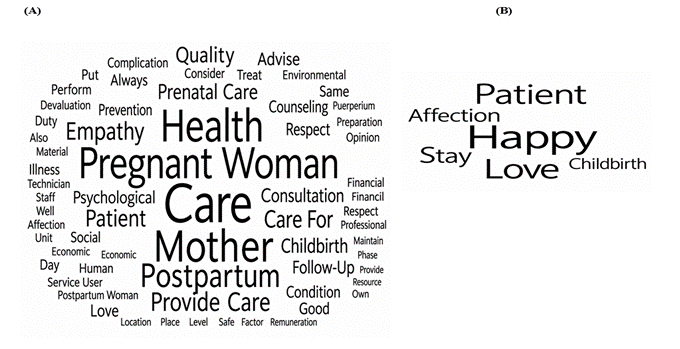
In the word cloud of Nursing Professionals (Figure 1A), the terms “care”, “childbirth”, “condition”, “good”, and “lack” stood out, followed by “respect”, “empathy”, “resources”, and “remuneration”. In the word cloud of Community Midwives (Figure 1B), the terms “stay”, “patient”, “love”, “affection”, “happy”, and “childbirth” stood out; the terms “respect” and “mom” also appeared less frequently in the corpus, outside the word cloud.
Figura 1 - Word clouds of responses regarding humanization in the pregnancy-puerperium cycle: (A) Nursing Professionals; (B) Community Midwives. Bailundo, Huambo, Angola, 2023.
Source: Research data (2023).
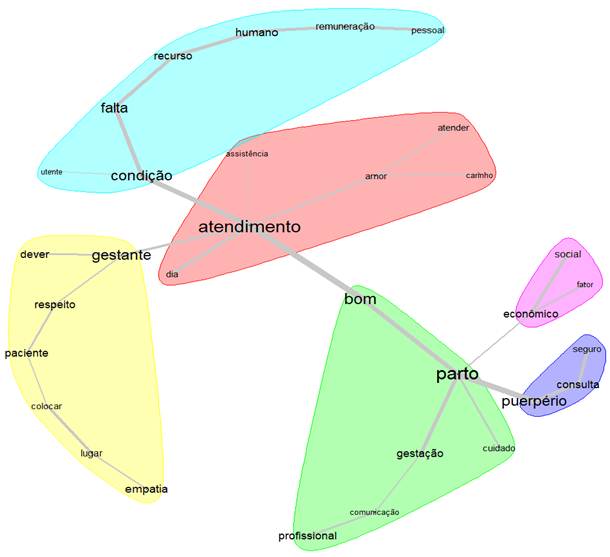
In the similarity analysis of the responses from Nursing Professionals (Figure 2), the term “care” occupied the central position, with the strongest connection in the sequence “good–care–condition”. From “condition”, an axis emerged comprising “lack”, “resources”, “human”, “remuneration”, and “staff”; “care” was also linked to “love” and “affection”, while “pregnant woman” was linked to “respect”, “empathy”, and “putting oneself in another’s place”. The terms “human” and “staff” stemmed primarily from the expressions “human resources” and “devaluation of staff”.
Figure 2 - Similarity analysis of Nursing Professionals’ responses regarding humanization during the pregnancy-puerperium cycle. Bailundo, Huambo, Angola (2023).
Source: Research data (2023).
The accounts provided by Nursing Professionals revealed different dimensions attributed to humanization, including a welcoming approach, respect, empathy, comfort, and attention to women's needs, as well as the material conditions required for care. These perceptions are exemplified in the following excerpts:
[…] in which the patient leaves fully satisfied with the care provided (NP 5).
[…] ensuring that the necessary conditions are available from pregnancy through childbirth and the puerperium, so that the service user does not have to buy anything and there are no delays in care (NP 9).
Providing care, comfort, promoting safety and trust, and offering guidance throughout these periods (NP 12).
[…] providing care to service users with love and affection […], provided that the facility has the material resources necessary to perform the work (NP 14).
[…] having a humanistic spirit and treating the client as if they were in my own place (NP 15).
Nursing Professionals also identified factors that may interfere with the humanization of care, particularly working conditions, the availability of human and material resources, remuneration, and communication in care. Ethical, social, economic, and psychological aspects also emerged in the responses, as illustrated by the following accounts:
Remuneration, working conditions, and lack of human resources (NP 10; NP 23; NP 25; NP 26; NP 27).
[…] satisfaction and adjustment of the Nursing team and the work environment; salary adjustments for professionals (NP 33).
[…] ethics and teaching skills are necessary to facilitate communication between the professional and the patient (NP 36).
[…] lack of materials to perform the job; […] lack of medications in hospitals (NP 50).
In the responses from Community Midwives, emphasis was placed on respect, affection, attentiveness, and remaining alongside women during labor, as well as the importance of continuous support until birth. These perceptions are exemplified in the following excerpts:
When I stay with the patient, I must show love (CM 2).
Doing good, showing respect and affection when caring for others, for the pregnant woman (CM 4, translated from Umbundu).
Providing care and support during childbirth. Showing her love and affection (CM 5, translated from Umbundu).
It is to have love and be happy with a patient mom (CM 7).
It is love, respect, and affection (CM 9).
[…] the way of providing care to mothers during labor, following up closely and accompanying them in the best possible way (CM 12).
The responses from Nursing Professionals and Community Midwives converged on aspects related to respect, a welcoming approach, and attention to women. Among Nursing Professionals, references also emerged to working conditions, available resources, and communication in care, whereas among Community Midwives, mentions of affection, being present alongside women, and providing support during labor were recurrent.
DISCUSSION
Nursing Professionals and Community Midwives recognized the importance of humanized care, but with different emphases. For Nursing Professionals, humanization depended on service conditions, such as human and material resources, remuneration, and work organization. For Community Midwives, it was associated with presence, affection, and supporting women during childbirth. This finding reinforces that respectful maternal care depends not only on individual conduct but also on the conditions of the healthcare system(9). In Rwanda, midwives working in district hospitals, although supportive of respectful care, identified work overload and a lack of materials as barriers(10). In South Africa, professionals at a public hospital also associated this type of care with a favorable environment and in-service training(11).
These differences begin with the profiles of the groups. The Nursing team was predominantly young, and a substantial proportion had only a few years of professional experience. This reinforces the need for continuous professional development in light of changes in obstetric practices and the demands of respectful maternal care. Studies conducted in African countries identify continuing education and training as strategies for improving the knowledge and skills of Nurses and Midwives(12,13).
In addition to being young, the team consisted mainly of Nursing Technicians, reflecting the challenges of workforce composition and qualification in healthcare in African countries(14). This profile, in itself, does not determine the quality of care but reinforces the importance of investing in professional training(15).
Another aspect of the participants' profile was the number of children. Some of the professionals who provided this information had large families, a characteristic that was predominant among Community Midwives. In Nursing, family demands may create work-family conflict(16) and affect professionals' availability and well-being. However, this relationship was not investigated, and the high number of missing responses limits the interpretation of this finding.
Community Midwives, in turn, were older, had low levels of formal education, and had extensive experience in childbirth care, with a profile similar to that of traditional birth attendants in other African countries(17). This practice is often learned through everyday experience, within the family, and through cultural elements of the community(18), which helps explain the role these women play in local maternal care.
These differences in profile are compounded by working conditions. The lack of sterilized materials reported by some Community Midwives compromises the safety of home births, given the importance of clean birth practices in preventing maternal and neonatal infections(19). This limitation reflects structural constraints and resource availability. Therefore, the formalization of Community Midwives' practice should be accompanied by training and institutional supervision. Training traditional birth attendants has been associated with reductions in perinatal and neonatal mortality, although the evidence remains limited(20).
Among Nursing Professionals, working conditions include work schedules, which determine time for rest and recovery. Extended working hours may be associated with fatigue and risks to care safety, highlighting the need for appropriate staffing levels and workload distribution(21).
In addition to work schedules, remuneration, which was a source of dissatisfaction among professionals, is an important component of professional recognition and is related to job satisfaction. However, valuing professionals goes beyond salary: it includes opportunities for development and career progression, factors that, together with remuneration and job satisfaction, influence Nursing performance(22).
These conditions help explain the perceptions of humanization. Both groups valued humanized care but differed in their views regarding the conditions required to provide it. Among Nursing Professionals, perceptions of limitations within the healthcare service were common, whereas among Community Midwives, the prevailing view was that humanized care could be provided at the place of birth. This difference appears to reflect their respective practice settings. In healthcare facilities, humanization depends on human and material resources that are not always available, a problem also reported in other African countries(10). At home, where Community Midwives practice and are sought out by families(7), care is based on being present and establishing a bond with women, which helps explain why they considered humanized care possible despite the lack of materials. Since the questions were not worded in the same way in the two questionnaires, this comparison should be interpreted with caution.
The open-ended responses from Nursing Professionals show that, for them, humanization has two dimensions. The first is relational and involves respect, empathy, a welcoming approach, comfort, communication, and the idea of putting oneself in the pregnant woman's place. The second is structural: in the similarity analysis, good care was linked to working conditions and, in turn, to the lack of human and material resources and remuneration. In other words, Nursing Professionals recognize the elements of humanized care but consider it dependent on the conditions of the healthcare service. These two dimensions, interpersonal relationships and an environment that supports care, are also components of respectful maternal care(8,23).
Among Community Midwives, the terms “stay”, “love”, “affection”, and “happy” predominated, associated with remaining alongside women and showing affection during labor. This form of care is consistent with continuous support during labor, which has positive effects on maternal and neonatal outcomes(24). However, the presence of a companion freely chosen by the woman is still ensured unevenly across healthcare services(25) and has faced structural and cultural barriers in Senegal(26). Thus, the presence of Community Midwives alongside women may contribute to the childbirth experience, particularly where support within healthcare facilities is limited.
Despite these differences, respect for women emerged in both groups, indicating common ground in their understanding of humanization. This finding is consistent with Angola's National Program for the Humanization of Healthcare(27) and with the principles of the Prenatal and Birth Humanization Program (PHPN), used in this study solely as a conceptual framework, without normative authority in Angola(28). The emphasis placed by Community Midwives on affection and bonding also aligns with what healthcare professionals in Brazil identify as the ethical value of humanized childbirth(29).
In this context, Nursing plays a central role in the humanization of care because of the close contact it maintains with women throughout their care. By combining technical and scientific knowledge with attention to each woman's needs, Nursing practice aligns with person-centered care(30). The complementary emphases of the two groups, one on service conditions and the other on closeness to women, reinforce the potential of collaborative work between Nursing Professionals and Community Midwives to improve maternal care in rural communities(6).
These findings should be interpreted in light of certain limitations. The study was conducted at a single healthcare facility and included a small number of Community Midwives, selected by convenience from among those participating in activities at the CMIB, which limits the results’ generalizability. The self-reported responses may have been influenced by social desirability bias. The corpus of Community Midwives was small and generated a word cloud with few terms; therefore, the lexical findings were interpreted alongside the open-ended responses, and the similarity analysis was restricted to Nursing Professionals. Finally, the cross-sectional and descriptive design does not allow cause-and-effect relationships to be established.
Nevertheless, this study brings together, in a single analysis, the perceptions of Nursing Professionals and Community Midwives regarding humanization during the pregnancy-puerperium cycle. The integration of quantitative and qualitative data revealed both the perceived conditions required for humanized care and the distinct emphases of each group. These findings may guide continuing education initiatives and the organization of care within the healthcare service. Studies conducted in other regions of Angola, using different research designs, may further explore these issues.
CONCLUSIONS
Humanization during the pregnancy-puerperium cycle was understood in complementary ways by the two groups: among Nursing Professionals, as relational care conditioned by the structure of the healthcare service; among Community Midwives, as an affectionate presence alongside women, with respect as a shared foundation. These findings indicate the need for better working conditions and continuing education for Nursing Professionals. Collaborative work between Nursing Professionals and Community Midwives may promote the integration of care and the appreciation of traditional knowledge, an aspect that warrants investigation in future studies.
REFERENCES
1. Silva FCA, Mansilla-Cordeiro EJ, Flores AA, Marsilha BA, Saavedra MIG. Perception of hospitalized patients regarding nursing care. Enfermería: Cuidados Humanizados. 2022;11(1):e2635. doi: 10.22235/ech.v11i1.2635
2. Batista MHJ, Araujo AA, Santos RF, Lima DV, Nunes TS, Souza ACM. Challenges of nursing in the face of humanized childbirth: perceptions of professionals about humanization in obstetrics. Saúde Coletiva. 2021;11(67):6949-62. doi: 10.36489/saudecoletiva.2021v11i67p6949-6962
3. Bourguignon AM, Grisotti M. A humanização do parto e nascimento no Brasil nas trajetórias de suas pesquisadoras. Hist Cienc Saude Manguinhos. 2020;27(2):485-502. doi: 10.1590/S0104-59702020000200010
4. Backes DS, Morais TR, Rosa CB, Haeffner LSB, Galvão DMPG, Pereira ADA. Care for women in the pregnancy-puerperium cycle from the perspective of health professionals in the light of complexity thinking. Rev Lat Am Enfermagem. 2025;33:e4458. doi: 10.1590/1518-8345.7313.4458
5. Ribeiro AS, Cunha RDT, Nascimento VO, Paula E, Ribeiro WA. O enfermeiro frente à humanização no trabalho de parto. Revista Ibero-Americana de Humanidades, Ciências e Educação. 2025;2(2):13-24. doi: 10.51891/rease.v2i02.20139
6. Musie MR, Mulaudzi FM, Anokwuru R, Sepeng NV. An inclusive framework for collaboration between midwives and traditional birth attendants and optimising maternal and child healthcare in restricted rural communities in South Africa: Policy considerations. Healthcare. 2024 Jan 31;12(3):363. doi: 10.3390/healthcare12030363
7. Gurara M, Muyldermans K, Jacquemys Y, Geertruyden JPV, Draulans V. Traditional birth attendants’ roles and homebirth choices in Ethiopia: A qualitative study. Women and Birth. 2020 Sept;33(5):e464-e472. doi: 10.1016/j.wombi.2019.09.004
8. Mira-Catalá P, Hernández-Aguado I, Chilet-Rosell E. Respectful maternity care interventions to address women mistreatment in childbirth: what has been done?. BMC Pregnancy Childbirth. 2024 Apr 26;24(1):322. doi: 10.1186/s12884-024-06524-w
9. Amsalu B, Aragaw A, Sintayehu Y, Sema A, Belay Y, Tadese G, et al. Respectful maternity care among laboring women in public hospitals of Benishangul Gumuz Region, Ethiopia: A mixed cross-sectional study with direct observations. SAGE Open Med. 2022;10:20503121221076995. doi: 10.1177/20503121221076995
10. Uwamahoro V, Semasaka JPS, Ndagijimana A, Humuza J. Perceptions and attitudes of midwives on respectful maternity care during childbirth: a qualitative study in three district hospitals of Kigali City of Rwanda. Pan Afr Med J. 2023;46:110. doi: 10.11604/pamj.2023.46.110.40764
11. Zwane SP, Chauke L. Providers' perceptions of respectful maternity care and enabling conditions in a regional hospital: a qualitative study. Int J Environ Res Public Health. 2025;22(10):1570. doi: 10.3390/ijerph22101570
12. Gakwerere M, Ndayisenga JP, Ngabonzima A, Uhawenimana TC, Yamuragiye A, Harindimana F, et al. Access to continuous professional development for capacity building among nurses and midwives providing emergency obstetric and neonatal care in Rwanda. BMC Health Serv Res. 2024;24(1):394. doi: 10.1186/s12913-023-10440-8
13. Yargawa J, Daniele M, Pickerill K, Vidler M, Koech A, Jah H, et al. Content and design of respectful maternity care training packages for health workers in sub-Saharan Africa: Scoping review. Int J Gynecol Obstet. 2025;168(3):857-874. doi: 10.1002/ijgo.15938
14. Asamani JA, Bediakon KSB, Boniol M, Munga'tu JK, Christmals CD, Okoroafor SC, et al. State of the health workforce in the WHO African Region: decade review of progress and opportunities for policy reforms and investments. BMJ Glob Health. 2024;7(Suppl 1):e015952. doi: 10.1136/bmjgh-2024-015952
15. Okoroafor SC, Ahmat A, Asamani JA, Millogo JJS, Nyoni J. An overview of health workforce education and accreditation in Africa: implications for scaling-up capacity and quality. Hum Resour Health. 2022;20(1):37. doi: 10.1186/s12960-022-00735-y
16. Asiedu EEA, Annor F, Amponsah-Tawiah K, Dartey-Baah K. Juggling family and professional caring: Role demands, work–family conflict and burnout among registered nurses in Ghana. Nurs Open. 2018;5(4):611-20. doi: 10.1002/nop2.178
17. Esan DT, Ayenioye OH, Ajayi PO, Sokan-Adeaga AL. Traditional birth attendants’ knowledge, preventive and management practices for postpartum haemorrhage in Osun State, Southwestern Nigeria. Sci Rep. 2023 July 29;13:12314. doi: 10.1038/s41598-023-39296-y
18. Aziato L, Omenyo CN. Initiation of traditional birth attendants and their traditional and spiritual practices during pregnancy and childbirth in Ghana. BMC Pregnancy Childbirth. 2018;18(1):64. doi: 10.1186/s12884-018-1691-7
19. Gebeyehu NA, Atalay YA, Tegegne KD, Biset G, Gelaw KA. Clean delivery kit use in low-and-middle-income countries: a systematic review and meta-analysis. BMC Pregnancy Childbirth. 2024 Nov 27;24:791. doi: 10.1186/s12884-024-06913-1
20. Dwivedi R, Shamim MA, Dwivedi P, Banerjee AR, Goel AD, Vyas V, et al. Maternal and child health training of traditional birth attendants and pregnancy outcomes: a systematic review and meta-analysis. J Epidemiol Glob Health. 2024;14(3):690-8. doi: 10.1007/s44197-024-00300-x
21. Scott-Marshall HK. Safe limits on work hours for the nursing profession: a rapid evidence review. Front Glob Womens Health. 2024;5:1455422. doi: 10.3389/fgwh.2024.1455422
22. Roza N, Supriyati Y, Kadir. The effect of organizational culture, career development remuneration and job satisfaction on nurse performance in regional general hospital in batam embung fatimah city. International Journal of Human Capital Management. 2022;6(1):38-53. doi: 10.21009/IJHCM.06.01.4
23. Shiindi-Mbidi TSN, Downing C, Temane A. Midwives' and women's experiences with respectful maternity care around the globe: a meta-synthesis. Women Birth. 2023;36(5):e461-70. doi: 10.1016/j.wombi.2023.04.002
24. Jayasundara DMCS, Jayawardane IA, Weliange SDS, Jayasingha TDKM, Madugalle TMSSB. Impact of continuous labor companion - who is the best: a systematic review and meta-analysis of randomized controlled trials. PLoS One. 2024;19(7):e0298852. doi: 10.1371/journal.pone.0298852
25. Bohren MA, Hazfiarini A, Vazquez Corona M, Colomar M, De Mucio B, Tunçalp Ö, et al. From global recommendations to (in)action: a scoping review of the coverage of companion of choice for women during labour and birth. PLOS Glob Public Health. 2023;3(2):e0001476. doi: 10.1371/journal.pgph.0001476
26. Gélinas E, Samb OM. Analysis of the social acceptability of a humanized childbirth intervention in Senegal: a qualitative study. Women Birth. 2023;36(1):e93-8. doi: 10.1016/j.wombi.2022.04.015
27. Ministério da Saúde (AO) Despacho n.º 1114/14, de 15 de maio de 2014. Aprova o Programa Nacional de Humanização da Assistência na Saúde. Diário da República, I Série, n.º 91, 15 maio 2014. Luanda (AO): Ministério da Saúde; 2014.
28. Ministério da Saúde (BR). Portaria GM/MS n.º 569, de 1º de junho de 2000. Institui, no âmbito do Sistema Único de Saúde, o Programa de Humanização no Pré-natal e Nascimento. Brasília: Ministério da Saúde; 2000.
29. Rodrigues DP, Alves VH, Paula CC, Vieira BDG, Pereira AV, Reis LC, et al. Humanized childbirth: the values of health professionals in daily obstetric care. Rev Bras Enferm. 2022;75(2):e20210052. doi: 10.1590/0034-7167-2021-0052
30. Reyes-Téllez Á, González-García A, Martín-Salvador A, Gázquez-López M, Martínez-García E, García-García I. Humanization of nursing care: a systematic review. Front Med. 2024 Sep 26;11:1446701. doi: 10.3389/fmed.2024.1446701
Funding and Acknowledgments
This research did not receive funding from public or private agencies, nor from non-profit institutions. There are no additional acknowledgments to declare.
Data Availability Statement
All content underlying the text of the article is contained within the manuscript.
Conflict of Interest Statement
None to declare.
Author Contributions
Substantial contribution to the conception and/or design of the study: Chamolehã JÁ, Gouveia MTO.
Contribution to the acquisition, analysis, and/or interpretation of data: Chamolehã JÁ, Oliveira ETA, Costa GR, Gouveia MTO.
Contribution to the drafting and/or critical revision and final approval of the published version: Chamolehã JÁ, Oliveira ETA, Costa GR, Nhamba LA, Magalhães RLB, Gouveia MTO.
Scientific Editor: Ítalo Arão Pereira Ribeiro. ORCID: https://orcid.org/0000-0003-0778-1447
Rev Enferm Atual In Derme 2026;100(4): e026116